Vitamins
For each vitamin, hold the same chain: what it does, when it runs short, what the deficiency looks like, and the look-alike or toxicity that catches people out. The fat-soluble ones fail together in fat malabsorption; the water-soluble ones tie to specific enzymes.
Fat-soluble versus water-soluble
L6 p.37Vitamins divide by solubility, and the division is clinically useful. Fat-soluble (A, D, E, K) need bile and intact fat absorption, are stored, and can reach toxic levels. Water-soluble (B vitamins and C) are mostly not stored (B12 is the exception), so deficiency develops faster and excess is usually excreted.
Teaching schematic
Fat-soluble (A, D, E, K)
- A: vision, epithelium
- D: bone, calcium
- E: antioxidant
- K: clotting factors
Energy metabolism
- B1 thiamine
- B2 riboflavin
- B3 niacin
- B5 pantothenate
- Biotin
Amino-acid metabolism
- B6 (pyridoxal phosphate)
RBC / neural
- Folate (B9)
- Cobalamin (B12)
Collagen
- Vitamin C (ascorbate)
Vitamin A
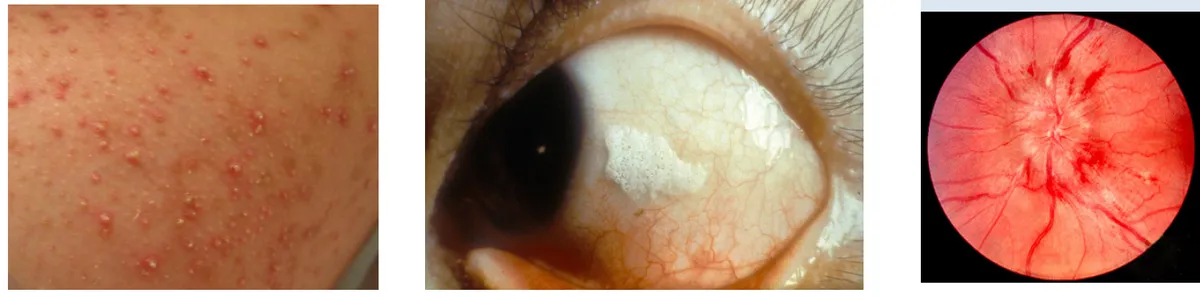
L6 p.38Function: retinal for vision (rhodopsin), retinoic acid for epithelial differentiation and growth. Deficiency setting: fat malabsorption, poverty. Findings: the earliest is night blindness; then squamous metaplasia of epithelia gives conjunctival keratin (Bitot spots), corneal softening (keratomalacia) and blindness, follicular hyperkeratosis of skin, and more infections. Toxicity: acute (pseudotumor cerebri, with headache and papilledema) and chronic (hepatotoxicity, bone and joint pain, teratogenic); isotretinoin is teratogenic.
Lecture image
Vitamin D
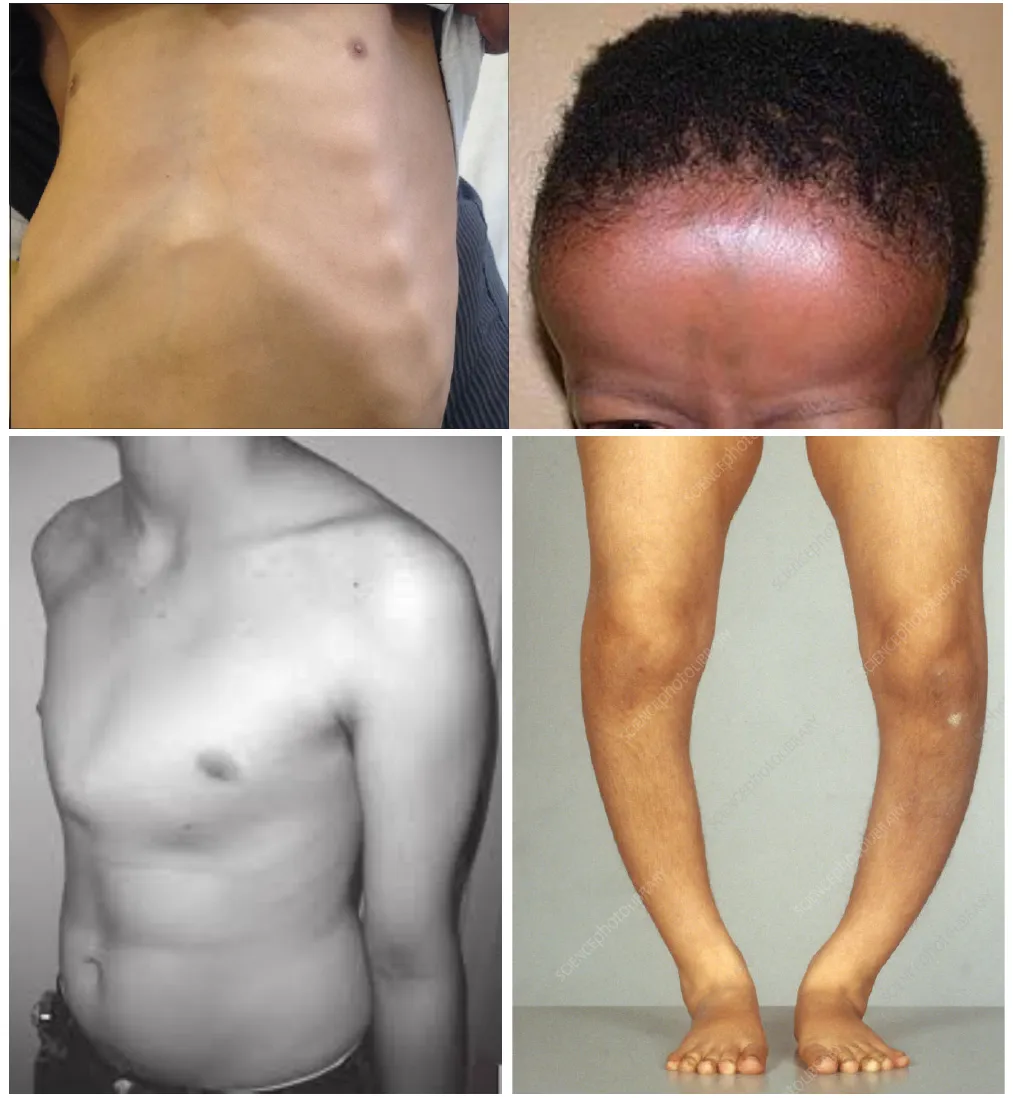
L6 p.39–40Function: raises serum calcium and phosphate for bone mineralization by increasing gut absorption. Activation: skin 7-dehydrocholesterol → (UV) cholecalciferol (D₃); liver adds 25-OH; kidney 1α-hydroxylase makes active 1,25-(OH)₂-D. Deficiency setting: little sun, fat malabsorption, renal or liver disease, exclusive breastfeeding, CYP450-inducing drugs. Findings: rickets in children (craniotabes, rachitic rosary, bowed legs, frontal bossing), osteomalacia in adults (unmineralized osteoid, soft bone, pathologic fractures), and tetany from low ionized calcium. Toxicity: hypercalcemia, metastatic calcification, renal stones.
Teaching schematic
Skin
7-dehydrocholesterol → cholecalciferol (D₃)
UV light
Liver
25-hydroxylase → 25-OH-D
Kidney
1α-hydroxylase → 1,25-(OH)₂-D (active)
PTH drives this step
Gut & bone
↑ calcium and phosphate absorption, mineralization
Deficiency: rickets (children), osteomalacia (adults). Excess: hypercalcemia, metastatic calcification.
Lecture image
Vitamin E
L6 p.41Function: a lipid-soluble antioxidant that protects membranes from free-radical peroxidation. Deficiency setting: fat malabsorption (including chronic pancreatitis, abetalipoproteinemia). Findings: a neurologic picture that mimics other causes, spinocerebellar ataxia, loss of posterior-column proprioception, peripheral neuropathy, plus hemolytic anemia (fragile red-cell membranes); in neonates, hemolysis, edema and thrombocytosis. Toxicity: synergizes with warfarin and can raise bleeding risk (prolonged PT).
Vitamin K
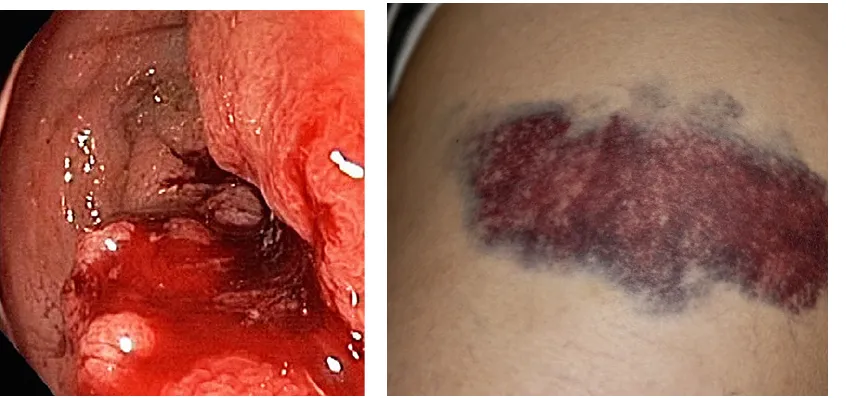
L6 p.41Function: cofactor for the carboxylation that activates clotting factors II, VII, IX and X and proteins C and S. Deficiency setting: newborns (sterile gut, low placental transfer, low in breast milk), fat malabsorption, broad-spectrum antibiotics, warfarin (which blocks the recycling enzyme). Findings: hemorrhagic disease of the newborn (intracranial and GI bleeding); in adults, GI bleeding and ecchymoses with a prolonged PT (and later PTT). Toxicity: synthetic menadione (K₃) can cause hemolysis and kernicterus in newborns; natural K₁ is safe.
Lecture image
B1 (thiamine)
L6 p.42Function: cofactor for pyruvate dehydrogenase, α-ketoglutarate dehydrogenase, branched-chain ketoacid dehydrogenase and transketolase (HMP shunt), the enzymes that feed the TCA cycle. Deficiency setting: alcohol use disorder (poor intake and absorption), chronic malnutrition, polished-rice diets. Findings split into two syndromes.
Thiamine deficiencyL6 p.42
| Syndrome | Features |
|---|---|
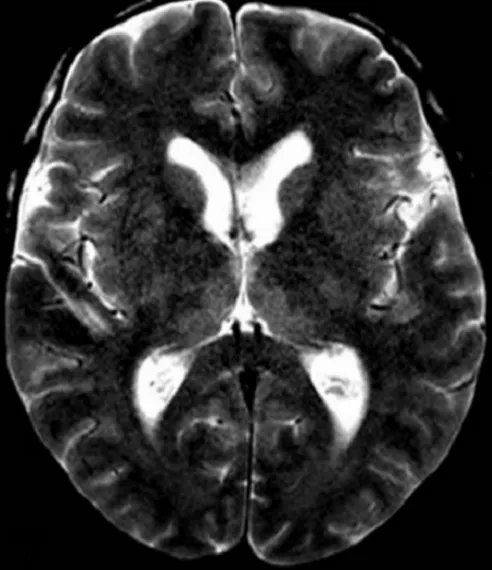
| Wernicke encephalopathy | Confusion, ataxia, ophthalmoplegia/nystagmus; hemorrhages in the mammillary bodies; reversible with thiamine |
| Korsakoff syndrome | Irreversible anterograde and retrograde amnesia with confabulation (limbic demyelination) |
| Dry beriberi | Symmetric peripheral neuropathy (demyelination) |
| Wet beriberi | Dilated cardiomyopathy with high-output failure and edema (cardiac muscle lacks ATP) |
Wernicke encephalopathy
- Features
- Confusion, ataxia, ophthalmoplegia/nystagmus; hemorrhages in the mammillary bodies; reversible with thiamine
Korsakoff syndrome
- Features
- Irreversible anterograde and retrograde amnesia with confabulation (limbic demyelination)
Dry beriberi
- Features
- Symmetric peripheral neuropathy (demyelination)
Wet beriberi
- Features
- Dilated cardiomyopathy with high-output failure and edema (cardiac muscle lacks ATP)
Case image
B2 (riboflavin) and B3 (niacin)
L6 p.43B2 (riboflavin) is the precursor of FAD/FMN. Deficiency gives cheilosis (cracked lips), angular stomatitis, glossitis (magenta tongue) and corneal neovascularization. The erythrocyte glutathione reductase assay (a FAD-dependent enzyme) detects it.
Lecture image
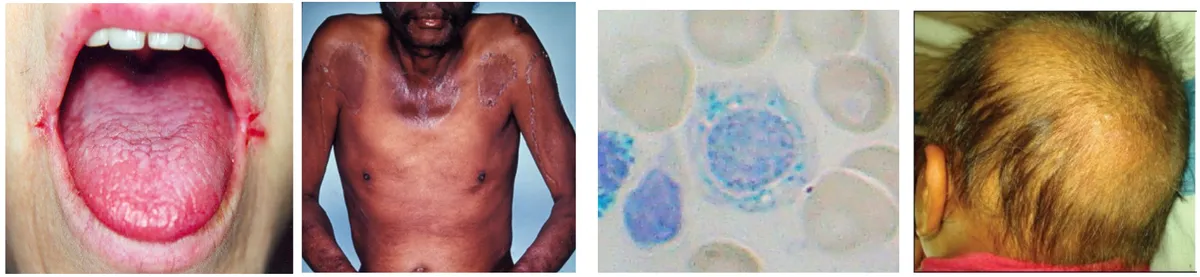
B3 (niacin) builds NAD⁺/NADP⁺. Deficiency is pellagra: the three Ds, dermatitis (photosensitive, on sun-exposed skin), diarrhea and dementia, progressing to death if untreated. Niacin is synthesized from tryptophan (needs B6), so pellagra appears when tryptophan or niacin is short.
Four settings for pellagraL6 p.43Ref. · Robbins; Hartnup, carcinoid, INH
| Cause | Why niacin falls |
|---|---|
| Corn-based (maize) diet | Niacin in corn is bound and poorly bioavailable, and corn is low in tryptophan |
| Hartnup disease | Autosomal recessive loss of neutral amino-acid (tryptophan) transport in gut and kidney |
| Carcinoid syndrome | Tumor diverts tryptophan into serotonin, leaving little for niacin |
| Isoniazid | Depletes vitamin B6, which is needed to make niacin from tryptophan |
Corn-based (maize) diet
- Why niacin falls
- Niacin in corn is bound and poorly bioavailable, and corn is low in tryptophan
Hartnup disease
- Why niacin falls
- Autosomal recessive loss of neutral amino-acid (tryptophan) transport in gut and kidney
Carcinoid syndrome
- Why niacin falls
- Tumor diverts tryptophan into serotonin, leaving little for niacin
Isoniazid
- Why niacin falls
- Depletes vitamin B6, which is needed to make niacin from tryptophan
B5, B6 and biotin
L6 p.37, 43- B5 (pantothenic acid): component of coenzyme A and fatty-acid synthase. Deficiency is rare: dermatitis and enteritis.
- B6 (pyridoxine → pyridoxal phosphate): cofactor for transaminases, decarboxylases, δ-ALA synthase (heme) and the conversion of tryptophan to niacin. Deficiency gives sideroblastic anemia (ringed sideroblasts), convulsions (impaired GABA synthesis) and peripheral neuropathy. Isoniazid causes B6 deficiency.
- Biotin: carboxylase cofactor (pyruvate carboxylase, others). Deficiency causes dermatitis, alopecia and lactic acidosis; blocked pyruvate carboxylase diverts pyruvate to lactate. Raw egg white (avidin) and excess antibiotics can cause it.
Folate and B12
L6 p.44–45Both make megaloblastic anemia with hypersegmented neutrophils, because both are needed for DNA synthesis. Two features separate them: the neurologic signs and the metabolites.
Teaching schematic
Methionine synthase (both B12 + folate)
Homocysteine + methyl-THF → methionine + THF. THF is needed for DNA synthesis.
Fails in either deficiency → megaloblastic anemia, high homocysteine.
Methylmalonyl-CoA mutase (B12 only)
Methylmalonyl-CoA → succinyl-CoA. Without B12, methylmalonic acid builds up and myelin synthesis is impaired.
B12 only → ↑ methylmalonic acid, neurologic signs.
B12 absorption is a relay: stomach acid and pepsin free dietary B12 from food, R-binder from saliva carries it to the duodenum, pancreatic proteases release it, intrinsic factor from gastric parietal cells then binds it, and the intrinsic-factor–B12 complex is absorbed by a receptor in the terminal ileum. Any broken link causes deficiency: autoimmune loss of parietal cells (pernicious anemia, no intrinsic factor), gastrectomy, pancreatic insufficiency, or terminal ileal resection or disease (Crohn). Because the liver stores years of B12, deficiency appears slowly.
Lecture image
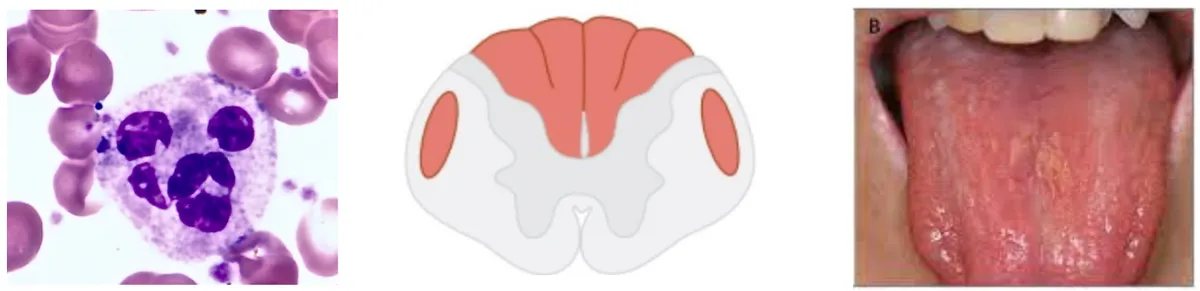
Folate versus B12L6 p.44–45
| Folate | B12 (cobalamin) | |
|---|---|---|
| Megaloblastic anemia | Yes | Yes |
| Neurologic signs | No | Yes: subacute combined degeneration (dorsal columns, lateral corticospinal), neuropathy, dementia |
| Homocysteine | High | High |
| Methylmalonic acid | Normal | High (mutase step fails) |
| Stores | Weeks to months | Years |
| Settings | Pregnancy, alcohol, methotrexate, phenytoin | Pernicious anemia, terminal ileal/gastric disease, vegans |
Megaloblastic anemia
- Folate
- Yes
- B12 (cobalamin)
- Yes
Neurologic signs
- Folate
- No
- B12 (cobalamin)
- Yes: subacute combined degeneration (dorsal columns, lateral corticospinal), neuropathy, dementia
Homocysteine
- Folate
- High
- B12 (cobalamin)
- High
Methylmalonic acid
- Folate
- Normal
- B12 (cobalamin)
- High (mutase step fails)
Stores
- Folate
- Weeks to months
- B12 (cobalamin)
- Years
Settings
- Folate
- Pregnancy, alcohol, methotrexate, phenytoin
- B12 (cobalamin)
- Pernicious anemia, terminal ileal/gastric disease, vegans
Core activity · Almost Twins
Almost Twins
Look-alike A
Vitamin B12 deficiency
B12 (cobalamin)
- Megaloblastic anemia
- Neurologic: subacute combined degeneration
- ↑ methylmalonic acid + homocysteine
- Megaloblastic anemia, hypersegmented neutrophils
- Neurologic: subacute combined degeneration, neuropathy
- Methylmalonic acid high and homocysteine high
- Stores last years
Look-alike A
Vitamin B12 deficiency
B12 (cobalamin)
- Megaloblastic anemia
- Neurologic: subacute combined degeneration
- ↑ methylmalonic acid + homocysteine
- Megaloblastic anemia, hypersegmented neutrophils
- Neurologic: subacute combined degeneration, neuropathy
- Methylmalonic acid high and homocysteine high
- Stores last years
Look-alike B
Folate deficiency
Folate
- Megaloblastic anemia
- No neurologic signs
- ↑ homocysteine, normal methylmalonic acid
- Megaloblastic anemia, hypersegmented neutrophils
- No neurologic signs
- Methylmalonic acid normal; homocysteine high
- Stores last weeks to months
Step 1 · What they share
What do they share?
Select every feature that both show.
C (ascorbic acid)
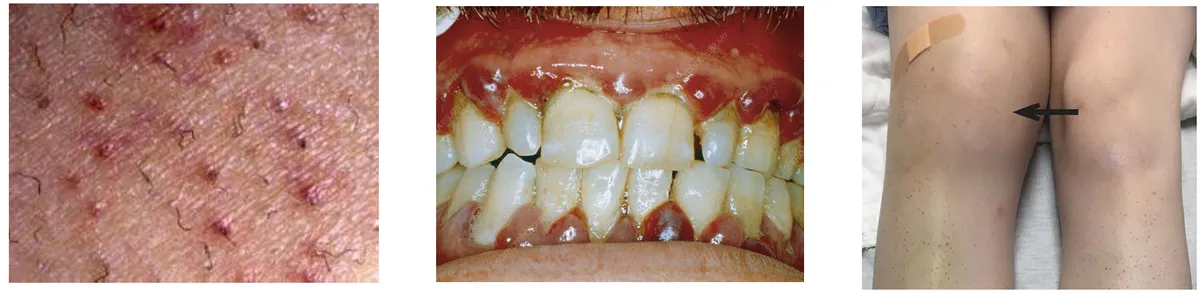
L6 p.46Function: cofactor for prolyl and lysyl hydroxylase, which hydroxylate proline and lysine residues so collagen triple helices cross-link and gain tensile strength; also an antioxidant and aids iron absorption. Deficiency setting: diets without fresh fruit and vegetables (elderly, alcohol use, food faddism). Findings (scurvy): weak collagen in vessel walls causes perifollicular and gum hemorrhage, bleeding swollen gums with loose teeth, hemarthrosis, corkscrew hairs, poor wound healing and anemia. Toxicity: calcium oxalate stones, false-negative stool occult blood.
Lecture image
Knowledge check · 6.5
Answer, read why, and try again whenever you like. Answers are kept in both study modes.
- Q1Vitamin C and collagen hydroxylationCh. VI cases p.2L6 p.46
A 23-year-old ballet dancer (BMI 17) has fatigue, a painful hemarthrosis of the knee, bleeding swollen gums, and perifollicular petechiae on her thighs. PT, PTT and platelet count are normal; bleeding time is prolonged.
Her condition is best explained by a defect in which process?
- Q2Vitamin A deficiencyCh. VI cases p.3L6 p.38
A 73-year-old woman with celiac disease and chronic diarrhea has recurrent respiratory infections, dry skin, stumbling in the dark, and triangular keratin plaques on the conjunctiva.
Which deficiency best explains these findings?
- Q3Riboflavin and FADCh. VI cases p.4L6 p.43
A 4-year-old recently arrived from Nigeria has a scaly rash on the eyebrows and nasolabial folds, a swollen red tongue, and fissures at the corners of the mouth. An erythrocyte glutathione reductase assay shows an increased activity coefficient.
The deficient vitamin is a precursor to which molecule?
- Q4Wernicke encephalopathy (thiamine)Ch. VI cases p.5L6 p.42
A 59-year-old man with alcohol use disorder is confused, has horizontal nystagmus, and walks with a wide-based unsteady gait. His brain MRI is shown.
Case MRI: Wernicke encephalopathy (T2). Supplementing which vitamin would most likely have prevented this?
- Q5PTH and renal 1α-hydroxylationCh. VI cases p.6L6 p.39
A 52-year-old man has fatigue, constipation and flank pain. Serum calcium is 11.2 mg/dL (high), phosphorus 2.5 mg/dL (low), and PTH 230 pg/mL (high).
Which step in vitamin D metabolism is most likely increased?
- Q6Vitamin E deficiencyCh. VI cases p.7L6 p.41
A 55-year-old man with chronic pancreatitis has an unsteady broad-based gait, distal weakness, reduced reflexes and an abnormal Romberg test. Hemoglobin is 11.9 with a normal MCV; haptoglobin is slightly low and LDH mildly raised.
Deficiency of which substance best explains this?
- Q7B12 deficiency after ileal resectionCh. VI cases p.8L6 p.44
A 37-year-old man had his terminal ileum resected for Crohn disease three years ago and takes no supplements. He now presents for follow-up.
Which physical finding is most likely?
- Q8Pellagra (niacin), corn dietMidterm sim. p.9–10L6 p.43
A 24-year-old food faddist eats almost only corn-based foods. She develops dermatitis on sun-exposed skin, diarrhea and increasing confusion.
Which condition does she most likely have?