Beyond Mendel: repeats, mitochondria, imprinting and multifactorial traits
Some disorders break the Mendelian ratios: a repeat that grows as it passes through mothers, DNA that only mothers transmit, genes that work only from one parent's copy, and traits built from many genes plus environment.
Three questions about any chromosome problem
L5 p.7, 10, 23Teaching schematic
1. How many chromosomes?
Counts dosage of whole chromosomes
- 47,+21: trisomy 21 (nondisjunction)
- 45,X: Turner
- 47,XXY: Klinefelter
Karyotype answers it
2. Where does the extra (or missing) material sit?
Count can be normal while dose is not
- 46, der(14;21),+21: three doses of 21q on 46 centromeres
- 46,XY,del(5p): cri-du-chat
- 45 in a healthy balanced carrier
Karyotype (large), FISH or microarray (small)
3. Which parent's copy is expressed?
Count and structure can both be normal
- Paternal UPD 15 → Angelman (46,XY, no deletion)
- Maternal UPD 15 → Prader–Willi
- Same deletion, different parent → different syndrome
Methylation or marker (SNP) studies answer it
Fragile X syndrome
L5 p.19Midterm sim. p.15Fragile X syndrome is the most common inherited cause of intellectual disability in boys (about 1 in 4,000 males and 1 in 8,000 females). The FMR1 gene at Xq27.3 begins with a run of CGG repeats in its 5′ untranslated region. Above about 200 repeats the run and the neighboring promoter CpG island become hypermethylated, transcription stops, and the RNA-binding protein FMRP, which restrains translation of many mRNAs at synapses, is absent. Cultured cells in folate-poor medium show a constriction at Xq27.3, the “fragile site” that named the disease.
Teaching schematic
Normal
< 45 CGG
Stable
Intermediate
45–54
Can drift
Premutation
55–200
Unmethylated, too much FMR1 mRNA → FXTAS (tremor, ataxia), ovarian insufficiency
Full mutation
> 200
Promoter CpG hypermethylated → FMR1 silenced → no FMRP → fragile X syndrome
The repeat expands only when transmitted by a woman. A man with a premutation (a “normal transmitting male”) passes it, unchanged, to all of his daughters; their sons are then at risk because the premutation can jump to a full mutation in the daughters' eggs. So the disease becomes more frequent and severe down the generations (anticipation). Females with a full mutation are variably affected (about half have learning difficulty) because X inactivation leaves a varying fraction of cells with the normal X active.
| Range | Methylated? | Clinical picture |
|---|---|---|
| Premutation 55–200 (lecture: 50–200) | No; mRNA overproduced | Fragile X–associated tremor/ataxia syndrome (FXTAS) in older men; primary ovarian insufficiency in ~20% of carrier women |
| Full mutation > 200 | Yes; gene silenced | Intellectual disability, autism and anxiety, long face, large prominent jaw, large everted ears, macrocephaly, postpubertal macroorchidism, mitral valve prolapse, hypermobile joints; self-injury and hand-biting |
Premutation 55–200 (lecture: 50–200)
- Methylated?
- No; mRNA overproduced
- Clinical picture
- Fragile X–associated tremor/ataxia syndrome (FXTAS) in older men; primary ovarian insufficiency in ~20% of carrier women
Full mutation > 200
- Methylated?
- Yes; gene silenced
- Clinical picture
- Intellectual disability, autism and anxiety, long face, large prominent jaw, large everted ears, macrocephaly, postpubertal macroorchidism, mitral valve prolapse, hypermobile joints; self-injury and hand-biting
Worked case · A 2-year-old who opens and closes his mother's purse
A 2-year-old boy avoids eye contact, does not speak and repeatedly opens and closes his mother's purse. He is at the 95th percentile for height and head circumference, with an elongated face and large ears (Sim. Q35).
What is the most likely cause?
Midterm sim. p.15Core activity · The Missing Arrow
The Missing Arrow
A boy inherits an FMR1 allele from his mother that expanded from 90 to over 600 CGG repeats. Complete the chain from DNA to phenotype.
One gap needs the mechanism that silences the gene; another needs the event that the brain actually lacks.
- Full mutation: > 200 CGG repeats in the 5′ untranslated region of FMR1 (Xq27.3)
- FMR1 transcription is shut off
- no FMR1 mRNA to translate
- Intellectual disability, autistic features, long face, large ears, macroorchidism after puberty
Cards
Tap or drag a card. Placing a used card moves it.
Mitochondrial inheritance
L5 p.21–22Each mitochondrion carries a small circular genome (37 genes) that encodes 13 subunits of the respiratory chain plus the tRNAs and rRNAs needed to make them. Children receive their mitochondria from the oocyte; sperm mitochondria are destroyed after fertilization. So an affected woman passes her mtDNA mutation to all of her children, and an affected man to none.
Cells contain hundreds to thousands of mtDNA copies, and a mutation usually affects only some of them: heteroplasmy. During oogenesis only a few copies seed each egg (the bottleneck), so siblings receive very different mutant fractions. Within a person, the fraction drifts between tissues as cells divide. Disease appears when the mutant fraction in a tissue crosses its threshold, which is lowest where energy demand is highest: brain, retina, skeletal and heart muscle, inner ear, β cells. This is why severity varies so much within one family.
Teaching schematic
The ATP–lactate crossover
- mtDNA defect in a respiratory-chain subunit or tRNA
- Oxidative phosphorylation fails
- NADH cannot be reoxidized; ATP falls
- Cells lean on glycolysis; pyruvate → lactate to regenerate NAD⁺
- Lactic acidosis, worse with exercise or illness
- Energy failure in brain and muscle
The lecture's three diseasesL5 p.21
| Disease | Defect | Findings |
|---|---|---|
| MELAS | tRNA-Leu (m.3243A>G) most often | Mitochondrial encephalomyopathy, lactic acidosis, strokelike episodes (not in a single arterial territory), seizures, short stature, hearing loss, diabetes |
| MERRF | tRNA-Lys (m.8344A>G) most often | Myoclonic epilepsy, ataxia, myopathy with ragged red fibers |
| Leber hereditary optic neuropathy | Complex I (NADH dehydrogenase) subunits | Subacute, painless, bilateral central vision loss in teens and young adults, males > females; usually permanent; sometimes tremor or MS-like illness |
MELAS
- Defect
- tRNA-Leu (m.3243A>G) most often
- Findings
- Mitochondrial encephalomyopathy, lactic acidosis, strokelike episodes (not in a single arterial territory), seizures, short stature, hearing loss, diabetes
MERRF
- Defect
- tRNA-Lys (m.8344A>G) most often
- Findings
- Myoclonic epilepsy, ataxia, myopathy with ragged red fibers
Leber hereditary optic neuropathy
- Defect
- Complex I (NADH dehydrogenase) subunits
- Findings
- Subacute, painless, bilateral central vision loss in teens and young adults, males > females; usually permanent; sometimes tremor or MS-like illness
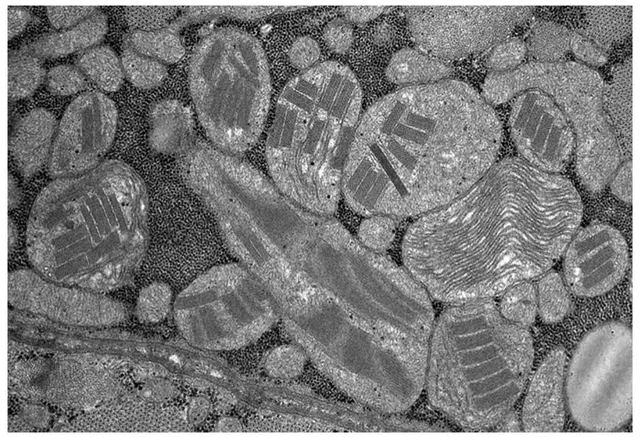
On a muscle biopsy stained with modified Gomori trichrome, ragged red fibers are fibers whose rims are packed with red-staining mitochondria: the cell has made more mitochondria to compensate for their poor function. Electron microscopy shows enlarged mitochondria with paracrystalline (“parking lot”) inclusions.
Lecture image
Genomic imprinting: Prader–Willi and Angelman
L5 p.23Ch. V cases p.11Midterm sim. p.15For most genes both parental copies work. For a few hundred imprinted genes, one parent's copy is silenced by DNA methylation set in the egg or sperm, so only the other parent's copy is expressed. The mark is erased and reset in each generation according to the sex of the transmitting parent. Losing the only expressed copy causes disease even though the other copy is perfectly normal.
Chromosome 15q11–q13 holds two neighboring sets. Genes such as SNRPN and the SNORD116 snoRNA cluster are expressed only from the paternal copy; UBE3A is expressed only from the maternal copy in neurons. The same region can therefore cause two different diseases depending on which parent's contribution is missing.
Teaching schematic
Normal
PWS genes ✓ · UBE3A ✓
One working copy of each
Paternal deletion
PWS genes ✗ · UBE3A ✓
Prader–Willi (~70%)
Maternal UPD
PWS genes ✗ · UBE3A ✓
Prader–Willi (~25%)
Maternal deletion
PWS genes ✓ · UBE3A ✗
Angelman (~70%)
Paternal UPD
PWS genes ✓ · UBE3A ✗
Angelman (~5%)
Maternal UBE3A mutation
PWS genes ✓ · UBE3A ✗
Angelman (~10%)
Blue = paternal 15, pink = maternal 15. Green box = working copy, gray = silenced by imprinting (methylation), dashed red = deleted.
Prader–Willi syndrome (no paternal copy)
- Paternal deletion (~70%), maternal uniparental disomy (~25%), imprinting defect
- Neonatal hypotonia and poor feeding, then hyperphagia and obesity from early childhood
- Hypogonadism (undescended testes), short stature, small hands and feet, almond-shaped eyes, thin upper lip
- Mild–moderate intellectual disability, temper outbursts, skin picking
Angelman syndrome (no maternal UBE3A)
- Maternal deletion (~70%), paternal UPD (~5%), UBE3A mutation (~10%), imprinting defect
- Severe intellectual disability, little or no speech
- Seizures, ataxic gait, hand-flapping, frequent inappropriate laughter (“happy puppet”)
- Microcephaly, prominent mandible, strabismus
Uniparental disomy (UPD) means both copies of a chromosome come from one parent. It usually starts as a trisomic conceptus that loses one extra chromosome (trisomy rescue): if the lost one was the single copy from the other parent, the embryo is left with two copies from one parent. The count is 46 and the structure normal, so the karyotype looks normal; methylation studies (or SNP marker analysis) reveal it.
Worked case · A laughing boy with a normal karyotype
An 8-year-old boy has developmental delay, tonic-clonic seizures, a protruding mandible, strabismus, a laughing expression, an unsteady gait and about 200 words. Karyotype: 46,XY without deletions (Ch. V Q10).
Which mechanism best explains his findings?
Ch. V cases p.11Worked case · Always hungry
A 5-year-old boy has angry outbursts and constant hunger. He is at the 25th percentile for height and above the 95th for weight, with central obesity, undescended testes, almond-shaped eyes and a thin upper lip. His parents are healthy (Sim. Q36).
Which genetic change fits?
Midterm sim. p.15Pedigree Lab · exercise
Whose copy is missing?
In 15q11–q13 some genes work only from the paternal copy (the SNRPN/SNORD116 cluster) and UBE3A works only from the maternal copy in neurons; the other copy is silenced by methylation. For each child, decide whose working copy is missing, then name the syndrome.
0 of 6 solved
Deletion on the father's chromosome
Blue = from father (P), pink = from mother (M). Expression is shown after you check.
A floppy newborn who fed poorly becomes a hyperphagic, obese preschooler. FISH shows a 15q11–q13 deletion on the chromosome inherited from his father.
1. Whose working copy of 15q11–q13 is missing?
2. What is the result?
Feedback appears here after you check.
Core activity · Almost Twins
Almost Twins
Look-alike A
Prader–Willi syndrome
Paternal deletion
PWS genes ✗ · UBE3A ✓
Prader–Willi (~70%)
Maternal UPD
PWS genes ✗ · UBE3A ✓
Prader–Willi (~25%)
Blue = paternal 15, pink = maternal 15. Green box = working copy, gray = silenced by imprinting (methylation), dashed red = deleted.
- Defect in 15q11–q13
- Paternal copy missing: paternal deletion (~70%) or maternal UPD (~25%)
- Neonatal hypotonia and poor feeding → hyperphagia, obesity, hypogonadism, small hands
- Mild to moderate intellectual disability; temper outbursts
Look-alike A
Prader–Willi syndrome
Paternal deletion
PWS genes ✗ · UBE3A ✓
Prader–Willi (~70%)
Maternal UPD
PWS genes ✗ · UBE3A ✓
Prader–Willi (~25%)
Blue = paternal 15, pink = maternal 15. Green box = working copy, gray = silenced by imprinting (methylation), dashed red = deleted.
- Defect in 15q11–q13
- Paternal copy missing: paternal deletion (~70%) or maternal UPD (~25%)
- Neonatal hypotonia and poor feeding → hyperphagia, obesity, hypogonadism, small hands
- Mild to moderate intellectual disability; temper outbursts
Look-alike B
Angelman syndrome
Maternal deletion
PWS genes ✓ · UBE3A ✗
Angelman (~70%)
Paternal UPD
PWS genes ✓ · UBE3A ✗
Angelman (~5%)
Blue = paternal 15, pink = maternal 15. Green box = working copy, gray = silenced by imprinting (methylation), dashed red = deleted.
- Defect in 15q11–q13
- Maternal copy missing: maternal deletion (~70%), paternal UPD (~5%), UBE3A mutation
- Seizures, ataxia, hand-flapping, inappropriate laughter, prognathism
- Severe intellectual disability, little or no speech
Step 1 · What they share
What do the two syndromes share?
Select every feature that both show.
Core activity · One Fact Changes
One Fact Changes
1 · The original case
A floppy newborn boy feeds poorly. At 4 years he eats constantly and is obese, with small hands, undescended testes and almond-shaped eyes. FISH shows a 15q11–q13 deletion on the chromosome 15 he inherited from his father.
What is the diagnosis?
Which fact decides the syndrome at the genetic level?
Multifactorial inheritance
L5 p.20Ch. V cases p.8Most common birth defects and adult diseases arise from many genes of small effect plus environment. Think of liability as a bell curve across the population; disease appears in those past a threshold. Relatives share genes, so their curve sits closer to the threshold; environment can push it either way. This model explains the recurrence rules: the risk for first-degree relatives is a few percent (not 25% or 50%), it rises with each affected relative and with severity, falls quickly in more distant relatives, and is higher when the affected person is of the less commonly affected sex (a girl with pyloric stenosis carries more liability than a boy).
Examples from the lectureL5 p.20
| Disorder | Environmental lever |
|---|---|
| Open neural tube defects (anencephaly, spina bifida) | Low maternal folate; valproate; maternal diabetes and obesity |
| Cleft lip and palate | Smoking, anticonvulsants, retinoids |
| Congenital heart defects | Maternal diabetes, rubella, alcohol, lithium |
| Type 2 diabetes | Obesity (down-regulates insulin receptors) |
| Pyloric stenosis | More common in boys |
| Gout, coronary artery disease | Diet, lipids, smoking |
Open neural tube defects (anencephaly, spina bifida)
- Environmental lever
- Low maternal folate; valproate; maternal diabetes and obesity
Cleft lip and palate
- Environmental lever
- Smoking, anticonvulsants, retinoids
Congenital heart defects
- Environmental lever
- Maternal diabetes, rubella, alcohol, lithium
Type 2 diabetes
- Environmental lever
- Obesity (down-regulates insulin receptors)
Pyloric stenosis
- Environmental lever
- More common in boys
Gout, coronary artery disease
- Environmental lever
- Diet, lipids, smoking
Lecture image
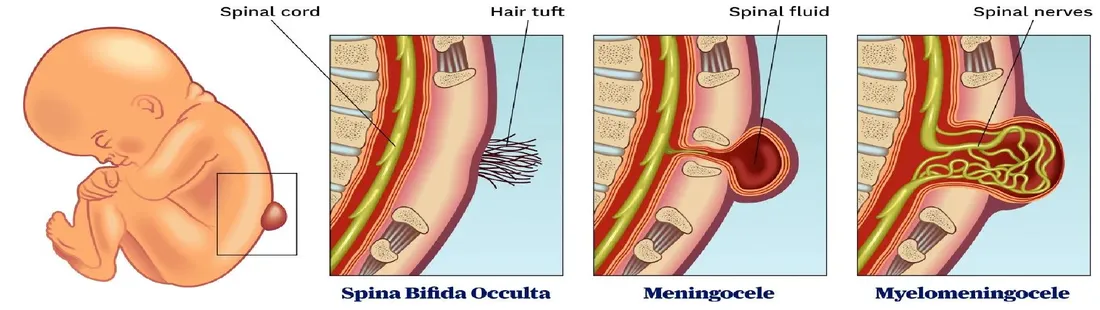
Worked case · A sac over the lumbar spine
A newborn has severe leg weakness. Lumbar vertebrae lack posterior arches; a thin membrane covers a sac containing meninges and spinal cord. The parents ask about future pregnancies (Ch. V Q7).
Which maternal supplement has been shown to reduce this defect?
Ch. V cases p.8Knowledge check · 5.3
Answer, read why, and try again whenever you like. Answers are kept in both study modes.
- Q1Fragile X: CGG expansionMidterm sim. p.15L5 p.19
A 2-year-old boy avoids eye contact, has no speech and repeatedly opens and closes his mother's purse. Height and head circumference are at the 95th percentile; he has elongated facial features and large ears (Sim. Q35).
What is the most likely cause?
- Q2Angelman: paternal UPDCh. V cases p.11L5 p.23
An 8-year-old boy has seizures, ataxia, a protruding mandible, strabismus, a laughing expression and very limited speech. Karyotype: 46,XY without deletions (Ch. V Q10).
Which genetic mechanism best explains his findings?
- Q3Prader–Willi: paternal lossMidterm sim. p.15L5 p.23
A 5-year-old boy is always hungry and has angry outbursts. He is short with central obesity, undescended testes, almond-shaped eyes and a thin upper lip; his parents are healthy (Sim. Q36).
Which genetic change is most likely?
- Q4Mitochondrial pedigree (image)L5 p.21
- male
- female
- affected
- known carrier
- proband
In the family shown, which inheritance pattern fits best?
- Q5NTD prevention: folateCh. V cases p.8L5 p.20
A neonate has a lumbar sac covered by a thin membrane containing meninges and spinal cord, with severe leg weakness. The parents ask about future pregnancies (Ch. V Q7).
Which maternal dietary supplement reduces the incidence of this defect?
- Q6Premutation vs full mutationL5 p.19
A 64-year-old man develops intention tremor, gait ataxia and mild cognitive decline. His daughter's son has fragile X syndrome. The man's FMR1 allele has 110 CGG repeats and is unmethylated.
What mechanism best explains the man's own illness?
- Q7MERRF: ATP–lactate crossoverL5 p.21–22
A 19-year-old with myoclonic seizures and ataxia has a muscle biopsy showing fibers with red-staining rims on modified Gomori trichrome. Serum lactate rises sharply after exercise.
Why is lactate high?