Acid–base disorders
Read a blood gas in the same order every time: pH, the variable that explains it, the expected compensation, the anion gap, and then whatever the numbers still do not explain.
The workflow and the normal values
L4 p.23Normal arterial values: pH 7.35–7.45, PaCO₂ 35–45 mm Hg, HCO₃⁻ 22–26 mEq/L. The middle values, 7.40, 40 and 24, are the reference points for every compensation formula. The three are tied together by the Henderson–Hasselbalch equation: pH depends on the ratio of bicarbonate (set by the kidney) to dissolved CO₂ (set by the lungs), not on either alone.
Worked calculation · Henderson–Hasselbalch at normal values
- HCO₃⁻
- 24 mEq/L
- PaCO₂
- 40 mm Hg
- CO₂ solubility
- 0.03 mmol/L per mm Hg
Formula
pH = 6.1 + log₁₀ [HCO₃⁻ / (0.03 × PaCO₂)]
Teaching schematic
1 · pH
< 7.35 acidemia · > 7.45 alkalemia
2 · Primary
Which of PaCO₂ or HCO₃⁻ moves pH that way?
3 · Compensation
Winters 1.5 × HCO₃⁻ + 8 ± 2 · 0.7 × HCO₃⁻ + 21 · resp. 1/3.5 or 2/4 per 10
4 · Anion gap
Na⁺ − (Cl⁻ + HCO₃⁻) = 12 ± 2; + 2.5 per g/dL albumin below 4
5 · What is left?
Delta–delta (AG − 12)/(24 − HCO₃⁻) · osmolal gap > 10
- pH: below 7.35 is acidemia, above 7.45 alkalemia.
- Which variable explains it? In acidemia, a high PaCO₂ points to respiratory acidosis and a low HCO₃⁻ to metabolic acidosis; in alkalemia, a low PaCO₂ means respiratory alkalosis and a high HCO₃⁻ metabolic alkalosis.
- Expected compensation: calculate what the other variable should be. If the measured value is outside the expected range, a second primary disorder is present.
- Anion gap (in every metabolic acidosis, and worth calculating in any sick patient): high or normal gap? Correct it for a low albumin.
- What is left? In a high-gap acidosis compare ΔAG with ΔHCO₃⁻ (delta–delta) to find a hidden metabolic alkalosis or normal-gap acidosis; check the osmolal gap for toxic alcohols.
Four primary disorders and their expected compensation
L4 p.24–29Primary change, causes and compensationL4 p.24–29
| Disorder | Primary change | Causes (lecture) | Compensation | Expected value |
|---|---|---|---|---|
| Respiratory acidosis | PaCO₂ ↑ (alveolar hypoventilation) | CNS depression (opioids, trauma), airway obstruction (sleep apnea, obesity), chest wall disease, respiratory muscle weakness, COPD | Kidney retains HCO₃⁻ (takes 3–5 days) | Acute: HCO₃⁻ ↑ 1 per 10 mm Hg PaCO₂ ↑. Chronic: ↑ 3.5 per 10 |
| Respiratory alkalosis | PaCO₂ ↓ (alveolar hyperventilation) | Anxiety, high altitude, rib fracture (pain), pulmonary embolism; also salicylates, sepsis, pregnancy | Kidney excretes HCO₃⁻ | Acute: HCO₃⁻ ↓ 2 per 10 mm Hg PaCO₂ ↓. Chronic: ↓ 4–5 per 10 |
| Metabolic acidosis | HCO₃⁻ ↓ (acid added or HCO₃⁻ lost) | High gap: lactic, keto, salicylate, ethylene glycol, methanol, renal failure. Normal gap: diarrhea, renal tubular acidosis, pancreatic or biliary drainage | Hyperventilation within minutes to hours (Kussmaul) | Winters: PaCO₂ = 1.5 × HCO₃⁻ + 8 ± 2 |
| Metabolic alkalosis | HCO₃⁻ ↑ (H⁺ lost or HCO₃⁻ gained) | Vomiting, loop and thiazide diuretics, mineralocorticoid excess | Hypoventilation (limited by hypoxemia) | PaCO₂ = 0.7 × HCO₃⁻ + 21 ± 2 (≈ +0.7 per 1 mEq/L HCO₃⁻ rise) |
Respiratory acidosis
- Primary change
- PaCO₂ ↑ (alveolar hypoventilation)
- Causes (lecture)
- CNS depression (opioids, trauma), airway obstruction (sleep apnea, obesity), chest wall disease, respiratory muscle weakness, COPD
- Compensation
- Kidney retains HCO₃⁻ (takes 3–5 days)
- Expected value
- Acute: HCO₃⁻ ↑ 1 per 10 mm Hg PaCO₂ ↑. Chronic: ↑ 3.5 per 10
Respiratory alkalosis
- Primary change
- PaCO₂ ↓ (alveolar hyperventilation)
- Causes (lecture)
- Anxiety, high altitude, rib fracture (pain), pulmonary embolism; also salicylates, sepsis, pregnancy
- Compensation
- Kidney excretes HCO₃⁻
- Expected value
- Acute: HCO₃⁻ ↓ 2 per 10 mm Hg PaCO₂ ↓. Chronic: ↓ 4–5 per 10
Metabolic acidosis
- Primary change
- HCO₃⁻ ↓ (acid added or HCO₃⁻ lost)
- Causes (lecture)
- High gap: lactic, keto, salicylate, ethylene glycol, methanol, renal failure. Normal gap: diarrhea, renal tubular acidosis, pancreatic or biliary drainage
- Compensation
- Hyperventilation within minutes to hours (Kussmaul)
- Expected value
- Winters: PaCO₂ = 1.5 × HCO₃⁻ + 8 ± 2
Metabolic alkalosis
- Primary change
- HCO₃⁻ ↑ (H⁺ lost or HCO₃⁻ gained)
- Causes (lecture)
- Vomiting, loop and thiazide diuretics, mineralocorticoid excess
- Compensation
- Hypoventilation (limited by hypoxemia)
- Expected value
- PaCO₂ = 0.7 × HCO₃⁻ + 21 ± 2 (≈ +0.7 per 1 mEq/L HCO₃⁻ rise)
The clinical signs follow the chemistry. CO₂ dilates cerebral vessels, so respiratory acidosis causes somnolence, headache and raised intracranial pressure, with cyanosis from the accompanying hypoxemia. Respiratory alkalosis lowers ionized calcium (more calcium binds albumin at high pH), so it causes lightheadedness, perioral numbness, Chvostek sign and carpopedal spasm. Metabolic acidosis stimulates central and peripheral chemoreceptors, producing Kussmaul breathing: deep, regular, sighing breaths with a large tidal volume that blow off CO₂ (classic in DKA, but present in any severe metabolic acidosis); acidosis also dilates arterioles (warm skin) and weakens myocardial contraction.
Compensation or a second primary disorder?
Expected compensation
- A secondary change in the other variable, in the same direction as the primary one (HCO₃⁻ ↓ → PaCO₂ ↓)
- Size predicted by the formula; the measured value falls inside the range
- Moves pH back toward 7.40 but never reaches or passes it
- Needs no separate cause: it is the body's response
Second primary disorder
- The other variable is outside the predicted range, or moves the opposite way
- pH normal with clearly abnormal PaCO₂ and HCO₃⁻, or pH extreme
- Needs its own cause: a reason to hypoventilate (opioids, COPD, exhaustion) or hyperventilate (salicylate, sepsis, PE), vomit or take a diuretic
- Name it as a disorder: “metabolic acidosis with respiratory acidosis”
Worked calculation · Winters formula in ketoacidosis
- pH
- 7.30
- HCO₃⁻
- 12 mEq/L
- PaCO₂ measured
- 25 mm Hg
Formula
Expected PaCO₂ = 1.5 × HCO₃⁻ + 8 ± 2
L4 p.26Worked calculation · Acute or chronic respiratory acidosis?
- PaCO₂
- 60 mm Hg (20 above 40)
- HCO₃⁻ measured
- 31 mEq/L
Formula
Acute: HCO₃⁻ = 24 + 1 × (ΔPaCO₂/10); chronic: HCO₃⁻ = 24 + 3.5 × (ΔPaCO₂/10)
L4 p.24Anion gap: high-gap and normal-gap acidosis
L4 p.26–28Plasma is electrically neutral, but routine panels measure only some ions. The anion gap is the measured cations minus the measured anions: AG = Na⁺ − (Cl⁻ + HCO₃⁻), normally 12 ± 2 mEq/L in the lecture's units (reference ranges vary by laboratory). The gap is made of unmeasured anions that are always there, mostly albumin, plus phosphate and sulfate.
When an acid HA is added, its H⁺ is buffered by bicarbonate (H⁺ + HCO₃⁻ → H₂CO₃ → H₂O + CO₂), so HCO₃⁻ falls. Its anion A⁻ stays, unmeasured, so the gap rises by about as much as bicarbonate falls: a high-gap acidosis. When bicarbonate itself is lost (diarrhea) or the kidney fails to regenerate or reclaim it (renal tubular acidosis), the kidney retains chloride in its place: Cl⁻ rises as HCO₃⁻ falls, the gap stays normal, and the acidosis is hyperchloremic (normal-gap).
Lecture image
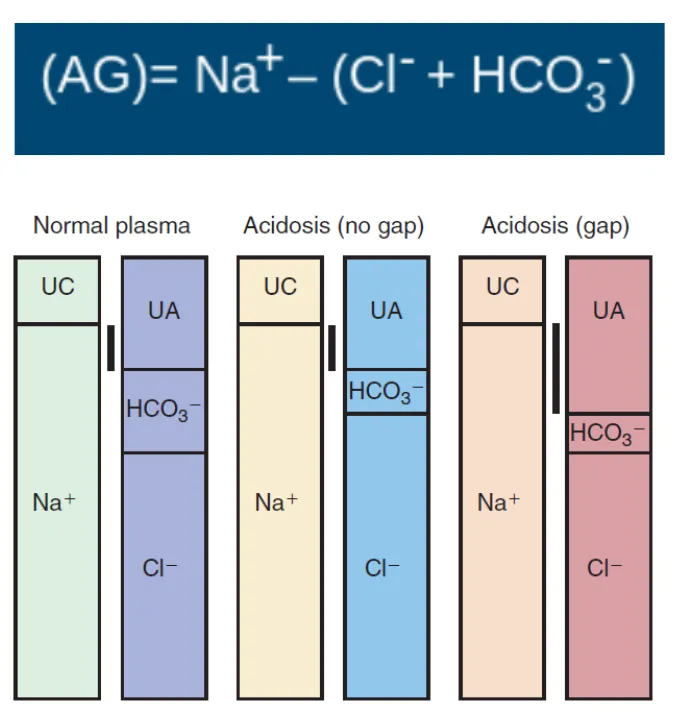
CausesL4 p.27–28
| High anion gap (an acid added) | Unmeasured anion | Normal anion gap (HCO₃⁻ lost or not regenerated) |
|---|---|---|
| Lactic acidosis (shock, hypoxia, sepsis) | Lactate | Diarrhea |
| Ketoacidosis (diabetic, alcoholic, starvation) | Acetoacetate, β-hydroxybutyrate | Renal tubular acidosis |
| Renal failure | Sulfate, phosphate | Pancreatic or biliary drainage (fistula) |
| Methanol; ethylene glycol | Formate; glycolate and oxalate | Large volumes of 0.9% saline (supporting context) |
| Salicylate poisoning | Salicylate, lactate, ketoacids | Carbonic anhydrase inhibitors (supporting context) |
Lactic acidosis (shock, hypoxia, sepsis)
- Unmeasured anion
- Lactate
- Normal anion gap (HCO₃⁻ lost or not regenerated)
- Diarrhea
Ketoacidosis (diabetic, alcoholic, starvation)
- Unmeasured anion
- Acetoacetate, β-hydroxybutyrate
- Normal anion gap (HCO₃⁻ lost or not regenerated)
- Renal tubular acidosis
Renal failure
- Unmeasured anion
- Sulfate, phosphate
- Normal anion gap (HCO₃⁻ lost or not regenerated)
- Pancreatic or biliary drainage (fistula)
Methanol; ethylene glycol
- Unmeasured anion
- Formate; glycolate and oxalate
- Normal anion gap (HCO₃⁻ lost or not regenerated)
- Large volumes of 0.9% saline (supporting context)
Salicylate poisoning
- Unmeasured anion
- Salicylate, lactate, ketoacids
- Normal anion gap (HCO₃⁻ lost or not regenerated)
- Carbonic anhydrase inhibitors (supporting context)
Worked calculation · A normal-gap acidosis
- Na⁺
- 138 mEq/L
- Cl⁻
- 114 mEq/L
- HCO₃⁻
- 14 mEq/L
- Setting
- Five days of watery diarrhea
Formula
AG = Na⁺ − (Cl⁻ + HCO₃⁻)
L4 p.28Worked calculation · Albumin hides a gap
- Na⁺
- 136 mEq/L
- Cl⁻
- 104 mEq/L
- HCO₃⁻
- 20 mEq/L
- Albumin
- 1.8 g/dL (cirrhosis; normal ≈ 4.0)
Formula
AG = Na⁺ − (Cl⁻ + HCO₃⁻); corrected AG = AG + 2.5 × (4.0 − albumin)
L4 p.27Worked calculation · Delta–delta: is anything else hiding?
- Na⁺, Cl⁻, HCO₃⁻
- 140, 100, 12 mEq/L
- Setting
- Septic shock, lactate 9 mmol/L
Formula
ΔAG / ΔHCO₃⁻ = (AG − 12) / (24 − HCO₃⁻)
Core activity · One Fact Changes
One Fact Changes
1 · The original case
A 45-year-old man has had profuse watery diarrhea for five days. Na⁺ 138, Cl⁻ 114, HCO₃⁻ 14 mEq/L. Arterial pH 7.31, PaCO₂ 29 mm Hg.
What kind of acidosis is this?
Which fact decided the type?
Toxic alcohols, salicylate and the osmolal gap
L4 p.3, 27, 30The osmolal gap is measured osmolality minus calculated osmolality (2 × Na⁺ + glucose/18 + BUN/2.8), normally under 10 mOsm/kg. A larger gap means an unmeasured, osmotically active substance. Ethanol raises it without an acidosis; methanol and ethylene glycol raise it early, while the parent alcohol is still present, and then cause a high-gap acidosis as alcohol dehydrogenase converts them to acids.
Three poisonings that open the anion gapL4 p.27, 30
| Poison | Toxic metabolite | Clues | Osmolal gap |
|---|---|---|---|
| Ethylene glycol (antifreeze) | Glycolic acid, oxalic acid | Calcium oxalate crystals in urine, acute kidney injury, hypocalcemia (muscle spasms), CNS depression | High |
| Methanol (windshield fluid, illicit spirits) | Formic acid | Blurred vision (“snowstorm”), optic disc edema, blindness; basal ganglia injury | High |
| Salicylate (aspirin) | Salicylate; lactate and ketoacids from uncoupled oxidative phosphorylation | Tinnitus, vomiting, early hyperventilation: respiratory alkalosis + high-gap acidosis | Normal or slightly raised |
Ethylene glycol (antifreeze)
- Toxic metabolite
- Glycolic acid, oxalic acid
- Clues
- Calcium oxalate crystals in urine, acute kidney injury, hypocalcemia (muscle spasms), CNS depression
- Osmolal gap
- High
Methanol (windshield fluid, illicit spirits)
- Toxic metabolite
- Formic acid
- Clues
- Blurred vision (“snowstorm”), optic disc edema, blindness; basal ganglia injury
- Osmolal gap
- High
Salicylate (aspirin)
- Toxic metabolite
- Salicylate; lactate and ketoacids from uncoupled oxidative phosphorylation
- Clues
- Tinnitus, vomiting, early hyperventilation: respiratory alkalosis + high-gap acidosis
- Osmolal gap
- Normal or slightly raised
Worked calculation · Osmolal gap
- Measured osmolality
- 320 mOsm/kg
- Na⁺
- 140 mEq/L
- Glucose
- 90 mg/dL
- BUN
- 14 mg/dL
Formula
Osmolal gap = measured − (2 × Na⁺ + glucose/18 + BUN/2.8)
L4 p.3Worked case: the man found in his vomitus (Sim. Q31)
Midterm sim. p.12–13Worked case · Simulation Q31
A 47-year-old man is found collapsed in a pool of vomitus. He is oriented only to self; pulse 103/min, respirations 30/min; muscle spasms in the arms and jaw. Serum: Na⁺ 137, Cl⁻ 99, HCO₃⁻ 8 mEq/L, osmolality 328 mOsm/kg; the calculated–observed osmolality difference is 32 mOsm/kg. Urine shows oxalate crystals. The answer choices are six arterial blood gases (pH / PaCO₂ / HCO₃⁻): A 7.52/52/41, B 7.46/29/20, C 7.28/51/23, D 7.29/30/14, E 7.49/33/24, F 7.34/56/29.
Before calculating, name the toxin and the expected type of gas. Then decide which bicarbonate goes into each formula.
Midterm sim. p.12–13Two bicarbonate values: which one goes whereMidterm sim. p.12–13
| Calculation | Bicarbonate to use | Why |
|---|---|---|
| Anion gap | Serum HCO₃⁻ = 8 (stem) | The gap balances ions measured on the same chemistry sample as Na⁺ and Cl⁻. |
| Expected PaCO₂ (Winters) | ABG HCO₃⁻ = 14 (option D) | Compensation is judged within one blood gas: the PaCO₂ being tested was measured with that bicarbonate (D is consistent: H–H gives pH 7.29). |
| Delta–delta | Serum HCO₃⁻ = 8 | It compares the rise in the gap with the fall in bicarbonate, so both must come from the same chemistry panel. |
Anion gap
- Bicarbonate to use
- Serum HCO₃⁻ = 8 (stem)
- Why
- The gap balances ions measured on the same chemistry sample as Na⁺ and Cl⁻.
Expected PaCO₂ (Winters)
- Bicarbonate to use
- ABG HCO₃⁻ = 14 (option D)
- Why
- Compensation is judged within one blood gas: the PaCO₂ being tested was measured with that bicarbonate (D is consistent: H–H gives pH 7.29).
Delta–delta
- Bicarbonate to use
- Serum HCO₃⁻ = 8
- Why
- It compares the rise in the gap with the fall in bicarbonate, so both must come from the same chemistry panel.
Worked calculation · Q31 · anion gap (serum values)
- Na⁺
- 137 mEq/L
- Cl⁻
- 99 mEq/L
- HCO₃⁻ (serum)
- 8 mEq/L
Formula
AG = Na⁺ − (Cl⁻ + HCO₃⁻)
Midterm sim. p.12L4 p.27Worked calculation · Q31 · osmolal gap
- Measured osmolality
- 328 mOsm/kg
- Calculated osmolality
- 296 mOsm/kg (2 × 137 = 274, plus glucose and BUN, which the stem does not list)
Formula
Osmolal gap = measured − calculated
Midterm sim. p.12Worked calculation · Q31 · expected PaCO₂ for option D (ABG values)
- Option D
- pH 7.29, PaCO₂ 30 mm Hg, HCO₃⁻ 14 mEq/L
Formula
Expected PaCO₂ = 1.5 × HCO₃⁻ + 8 ± 2
Midterm sim. p.13L4 p.26Worked calculation · Q31 · delta–delta (serum values)
- AG
- 30 mEq/L (normal 12)
- HCO₃⁻ (serum)
- 8 mEq/L (normal 24)
Formula
ΔAG / ΔHCO₃⁻ = (AG − 12) / (24 − HCO₃⁻)
Midterm sim. p.12Metabolic alkalosis: chloride-responsive or chloride-resistant
L4 p.29A metabolic alkalosis needs two things: something that generates it (loss of H⁺ from the stomach or kidney, or a gain of HCO₃⁻) and something that maintains it, because a healthy kidney excretes extra bicarbonate within hours. After vomiting, the maintenance comes from volume contraction and chloride depletion: low volume activates RAAS, aldosterone makes the collecting duct secrete H⁺ and K⁺, the proximal tubule reclaims more bicarbonate, and without chloride the kidney cannot exchange bicarbonate out into the urine. The urine can even be acidic despite alkalemia (paradoxical aciduria).
Does saline fix it?
Chloride-responsive (urine Cl⁻ < 20 mEq/L)
- Vomiting or nasogastric suction
- Loop and thiazide diuretics (urine Cl⁻ is high while the drug acts, low after)
- Mechanism: volume and Cl⁻ depletion maintain it
- Normal saline restores volume and chloride, and the kidney then excretes the HCO₃⁻
Chloride-resistant (urine Cl⁻ > 20 mEq/L)
- Primary aldosteronism (and other mineralocorticoid excess)
- Volume is normal or expanded, often with hypertension
- Mechanism: autonomous aldosterone drives H⁺ and K⁺ secretion
- Saline does not help; treat the hormone excess
Diuretics generate an alkalosis two ways: they remove bicarbonate-free fluid around an unchanged amount of bicarbonate (contraction alkalosis), and they deliver more sodium to the collecting duct while aldosterone is high, so H⁺ and K⁺ are secreted. Hypokalemia then sustains the alkalosis by shifting H⁺ into cells.
Core activity · The Missing Arrow
The Missing Arrow
A 34-year-old woman has vomited gastric juice for four days. Complete the chain from acid loss to a sustained alkalosis.
Separate what generates the alkalosis from what maintains it.
- Repeated vomiting of gastric HCl
- Plasma HCO₃⁻ rises (generation)
- water, sodium and chloride are lost with the vomitus
- normal saline restores volume and chloride
- Kidney excretes the excess HCO₃⁻: the alkalosis corrects (chloride-responsive)
Cards
Tap or drag a card. Placing a used card moves it.
Mixed disorders: the lecture's four examples
L4 p.30Suspect a mixed disorder when the pH is normal with abnormal PaCO₂ and HCO₃⁻, when the pH is extreme, or when the compensation calculation misses. The lecture's four examples are below; each calculation shows which number exposes the second disorder.
Worked calculation · Salicylate poisoning: respiratory alkalosis + high-gap acidosis
- pH
- 7.47
- PaCO₂
- 20 mm Hg
- HCO₃⁻
- 14 mEq/L
- Na⁺, Cl⁻
- 140, 103 mEq/L
Formula
AG = Na⁺ − (Cl⁻ + HCO₃⁻); expected PaCO₂ = 1.5 × HCO₃⁻ + 8 ± 2
L4 p.30Worked calculation · Chronic bronchitis on a loop diuretic: respiratory acidosis + metabolic alkalosis
- pH
- 7.40
- PaCO₂
- 60 mm Hg
- HCO₃⁻
- 36 mEq/L
Formula
Chronic respiratory acidosis: expected HCO₃⁻ = 24 + 3.5 × (PaCO₂ − 40)/10
L4 p.30Worked calculation · Cardiorespiratory arrest: metabolic + respiratory acidosis
- pH
- 6.99
- PaCO₂
- 60 mm Hg
- HCO₃⁻
- 14 mEq/L
- Na⁺, Cl⁻
- 138, 100 mEq/L
Formula
AG = Na⁺ − (Cl⁻ + HCO₃⁻); expected PaCO₂ = 1.5 × HCO₃⁻ + 8 ± 2
L4 p.30Worked calculation · Vomiting with hyperventilation: metabolic + respiratory alkalosis
- pH
- 7.65
- PaCO₂
- 30 mm Hg
- HCO₃⁻
- 32 mEq/L
- Setting
- Hyperemesis in the first trimester (progesterone drives ventilation)
Formula
Metabolic alkalosis: expected PaCO₂ = 0.7 × HCO₃⁻ + 21 ± 2
L4 p.30ABG Challenge
L4 p.23–30Midterm sim. p.12–14Work each gas in order. Each step unlocks only when the previous one is right, and every calculation is shown after you commit. Guided cases walks through six gases from the lecture and the simulation. Enter values lets you load a checked example or type your own pH, PaCO₂, HCO₃⁻, Na⁺, Cl⁻ and albumin, then calculate the expected compensation and the anion gap yourself; the tool checks each number and shows the formula with your values substituted.
Activity · Acid–base workbench
Work the gas, one decision at a time
Case
A 47-year-old man found collapsed in a pool of vomitus; respirations 30/min; muscle spasms in arms and jaw; oxalate crystals in the urine. Work up answer D of Simulation Q31.
- ABG (option D)
- pH 7.29 · PaCO₂ 30 mm Hg · HCO₃⁻ 14 mEq/L
- Serum
- Na⁺ 137 · Cl⁻ 99 · HCO₃⁻ 8 mEq/L
- Osmolality
- 328 mOsm/kg; calculated–measured gap 32
- 1. pH
- 2. Primary
- 3. Compensation
- 4. Anion gap
- 5. Second disorder?
Step 1 · pH
pH 7.29 is:
Core activity · One Fact Changes
One Fact Changes
1 · The original case
A 24-year-old woman with type 1 diabetes has vomiting and abdominal pain. Glucose 520 mg/dL; Na⁺ 134, Cl⁻ 98, HCO₃⁻ 12 mEq/L; ketones strongly positive. Arterial pH 7.30, PaCO₂ 25 mm Hg.
How do you describe her acid–base state?
Which fact decided whether there is a second disorder?
Knowledge check · 4.4
Answer, read why, and try again whenever you like. Answers are kept in both study modes.
- Q1High-AG acidosis from ethylene glycolMidterm sim. p.12–13L4 p.26–27
A 47-year-old man is found collapsed in a pool of vomitus. He is oriented only to self, pulse 103/min, respirations 30/min, with muscle spasms in the arms and jaw. Serum Na⁺ 137, Cl⁻ 99, HCO₃⁻ 8 mEq/L; osmolality 328 mOsm/kg; the difference between calculated and observed osmolality is 32 mOsm/kg. Urinalysis shows oxalate crystals.
Which arterial blood gas is most likely?
- Q2Chronic respiratory acidosisMidterm sim. p.14L4 p.24
A 44-year-old man has had a cough productive of thick yellow sputum for 5 months and similar symptoms for 4 months last year. He has smoked two packs a day for 20 years. He has expiratory wheezes and rhonchi in both lungs.
Which arterial blood gas is most likely?
- Q3Chloride-responsive metabolic alkalosisL4 p.29
A 34-year-old woman has vomited repeatedly for four days. pH 7.53, PaCO₂ 47 mm Hg, HCO₃⁻ 38 mEq/L, K⁺ 2.9 mEq/L, urine Cl⁻ 8 mEq/L.
Why will an infusion of normal saline correct her alkalosis?
- Q4PE: hypoxemia and respiratory alkalosisMidterm sim. p.13L4 p.25, 37
A 54-year-old woman has had sharp chest pain and shortness of breath for 1 day. Temperature 37.8 °C, pulse 110/min, respirations 30/min, BP 86/70 mm Hg. CT angiography shows a large embolus in the right pulmonary artery.
Which arterial blood gas is most likely (pH · PaO₂ · PaCO₂ · HCO₃⁻)?
- Q5Albumin-corrected anion gapL4 p.27
A 60-year-old woman with septic shock and an albumin of 2.0 g/dL has Na⁺ 138, Cl⁻ 108, HCO₃⁻ 18 mEq/L and a lactate of 5 mmol/L.
What is her albumin-corrected anion gap and what does it show?
- Q6Methanol and the osmolal gapL4 p.27
A 38-year-old man drank windshield washer fluid 18 hours ago. He now complains that his vision looks like a snowstorm. Anion gap 26 mEq/L; osmolal gap 28 mOsm/kg.
Which metabolite is injuring his optic nerves?