Body water compartments and tonicity
Water crosses cell membranes freely, so it goes wherever effective solutes pull it. Sodium concentration tells you about water; the amount of sodium tells you about extracellular volume.
Where body water lives
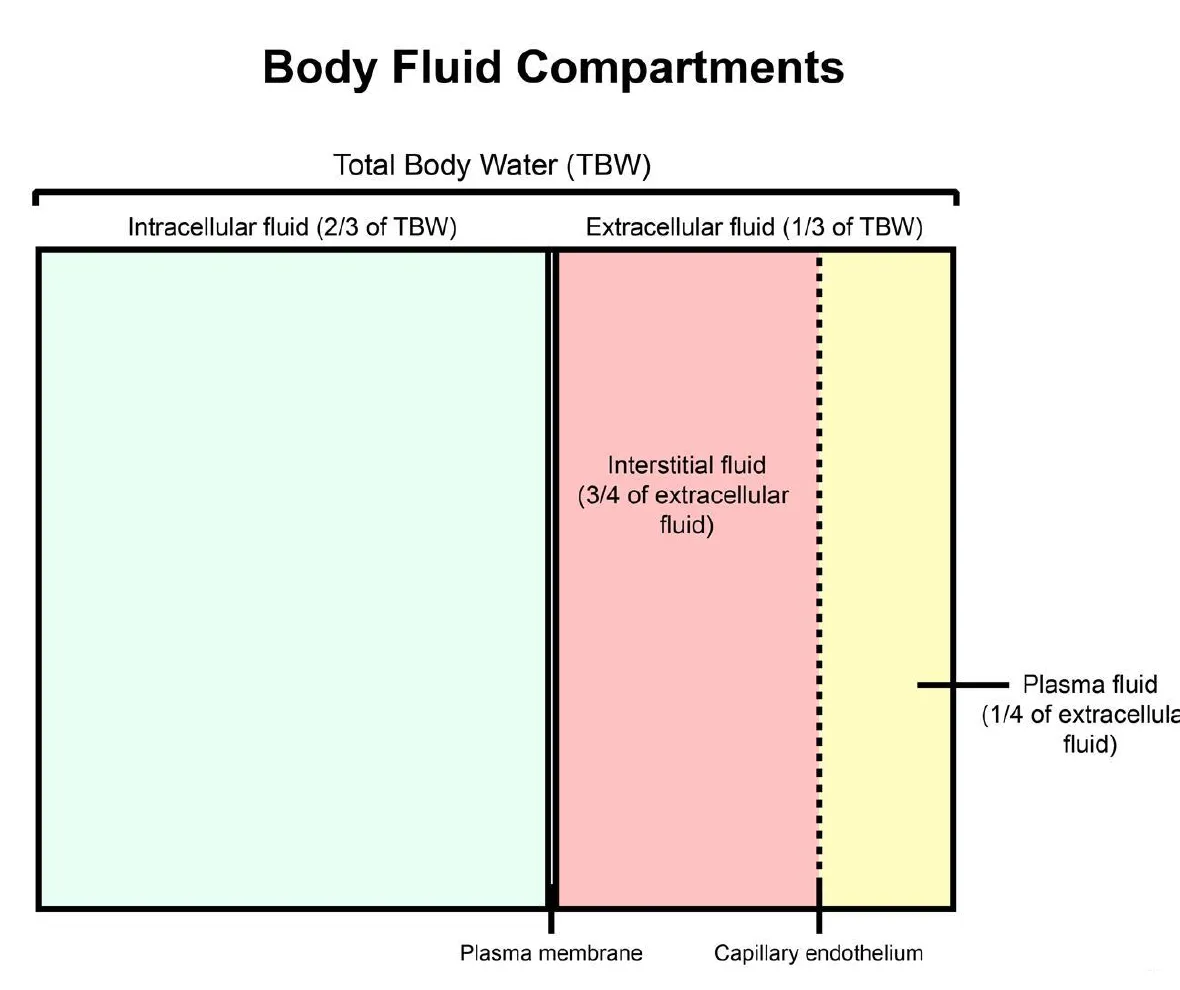
L4 p.2Water makes up about 60% of body weight in an adult man (about 42 L at 70 kg), less in women and older people (more fat, which holds little water) and more in infants. Two barriers divide it. The cell membrane separates intracellular fluid (ICF, two-thirds) from extracellular fluid (ECF, one-third). Inside the ECF, the capillary wall separates the interstitial fluid (three-quarters of ECF) from plasma (one-quarter of ECF).
Teaching schematic
ICF
2/3 · ≈ 28 L
Interstitial
≈ 10.5 L
Plasma 3.5 L
Cell membrane (solid blue line)
Water crosses freely; Na⁺ is pumped out, K⁺ in. Effective osmoles decide which way water moves: osmosis.
Capillary wall (dashed pink line)
Water and small solutes cross freely; albumin stays in plasma. Hydrostatic vs oncotic pressure: Starling forces.
70-kg man, total body water ≈ 42 L (60% of body weight). Teaching schematic.
What each barrier lets through
| Barrier | Water | Na⁺, Cl⁻, glucose, urea | Plasma protein (albumin) | Force that moves water across it |
|---|---|---|---|---|
| Cell membrane (ICF ↔ ECF) | Crosses freely (aquaporins) | Na⁺ kept out by the pump; glucose needs transporters; urea crosses | Not relevant | Osmosis driven by effective solutes |
| Capillary wall (plasma ↔ interstitium) | Crosses freely | All cross freely | Held in plasma | Starling forces: hydrostatic vs oncotic pressure (4.5) |
Cell membrane (ICF ↔ ECF)
- Water
- Crosses freely (aquaporins)
- Na⁺, Cl⁻, glucose, urea
- Na⁺ kept out by the pump; glucose needs transporters; urea crosses
- Plasma protein (albumin)
- Not relevant
- Force that moves water across it
- Osmosis driven by effective solutes
Capillary wall (plasma ↔ interstitium)
- Water
- Crosses freely
- Na⁺, Cl⁻, glucose, urea
- All cross freely
- Plasma protein (albumin)
- Held in plasma
- Force that moves water across it
- Starling forces: hydrostatic vs oncotic pressure (4.5)
Lecture slide
Osmolality versus tonicity
L4 p.3–4Osmosis is the movement of water across a semipermeable membrane toward the side with the higher solute concentration, until the concentrations are equal. Plasma osmolality counts every dissolved particle per kilogram of water; the normal range is 275–295 mOsm/kg.
Counting particles is not enough to predict water movement. A solute moves water across the cell membrane only if it stays on one side. Sodium (held out by the pump), glucose when insulin is lacking, and mannitol are effective osmoles. Urea crosses cell membranes and distributes equally inside and outside cells, so it raises osmolality without creating a gradient: it is an ineffective osmole. Ethanol behaves the same way. Tonicity (effective osmolality) counts only the effective osmoles, and it is tonicity that decides whether cells swell or shrink.
Teaching schematic
Na⁺ (and Cl⁻)
Pumped out of cells, so it stays in the ECF. Water moves toward it: effective.
Glucose without insulin
Cannot enter muscle and fat cells. Water leaves cells: effective (so is mannitol).
Urea
Crosses the membrane (dashed) and equalizes. Osmolality rises, but no water moves: ineffective.
Left chamber = cell, right chamber = ECF, blue line = cell membrane. Teaching schematic.
Worked calculation · Calculated plasma osmolality
- Serum Na⁺
- 140 mEq/L
- Glucose
- 90 mg/dL
- BUN
- 14 mg/dL
Formula
Posm = 2 × Na⁺ + glucose/18 + BUN/2.8
L4 p.3Worked calculation · High osmolality, normal tonicity (uremia)
- Serum Na⁺
- 140 mEq/L
- Glucose
- 90 mg/dL
- BUN
- 112 mg/dL (renal failure)
Formula
Posm = 2 × Na⁺ + glucose/18 + BUN/2.8; effective osmolality = 2 × Na⁺ + glucose/18
L4 p.3Sodium concentration reports water; total sodium sets ECF volume
L4 p.5, 8–11, 13–15Sodium is the main effective solute of the ECF, and water follows it so that osmolality stays the same inside and outside cells. Two consequences follow. The amount of sodium in the body (total body Na⁺) decides how big the ECF is: add sodium and water is pulled in with it; lose sodium and the ECF shrinks. The serum sodium concentration is a ratio, total body Na⁺ divided by total body water, so it tells you whether there is too much or too little water relative to sodium. The lecture writes it exactly that way: serum Na⁺ = TBNa⁺/TBW.
Separate the two questionsL4 p.5, 8
| Question | Measured by | Controlled by |
|---|---|---|
| How much water is there relative to solute? (Are cells swollen or shrunken?) | Serum Na⁺ concentration, plasma osmolality | ADH and thirst (water intake and excretion) |
| How big is the ECF? (Is the patient dry or edematous?) | Bedside examination: JVP, BP, skin turgor, edema | Total body Na⁺, through aldosterone, renal perfusion and natriuretic peptides |
How much water is there relative to solute? (Are cells swollen or shrunken?)
- Measured by
- Serum Na⁺ concentration, plasma osmolality
- Controlled by
- ADH and thirst (water intake and excretion)
How big is the ECF? (Is the patient dry or edematous?)
- Measured by
- Bedside examination: JVP, BP, skin turgor, edema
- Controlled by
- Total body Na⁺, through aldosterone, renal perfusion and natriuretic peptides
That is why a low sodium can occur with a shrunken ECF (thiazide user who lost salt), a normal-looking ECF (SIADH) or an expanded ECF with edema (heart failure). The sodium concentration is low in all three because water is high relative to sodium; the volume differs because total sodium differs. Section 4.2 works through each.
Reading the compartments at the bedside
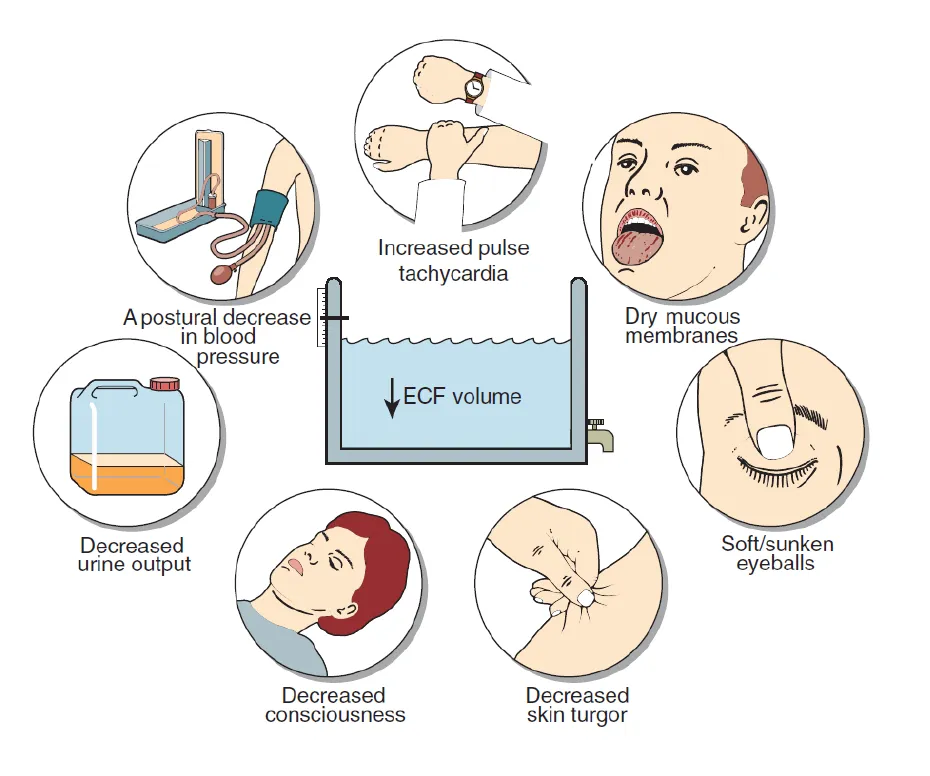
L4 p.6–8, 12, 19Each compartment change has its own signs. ECF contraction shows in the circulation and the skin; ECF expansion shows as edema, effusions and raised venous pressure. Cell swelling or shrinking shows mainly in the brain, because the skull leaves no room to swell and stretched bridging veins can tear when the brain shrinks.
Four changes, four sets of signsL4 p.6–8, 12, 19
| Change | Signs | Typical causes |
|---|---|---|
| ECF contraction (volume depletion) | Dry mucous membranes, reduced skin turgor (tenting), low BP (postural drop), tachycardia, flat neck veins (low JVP), sunken eyes, capillary refill > 2 s, low urine output, stupor | Diarrhea, vomiting, hemorrhage, diuretics, Addison disease |
| ECF expansion | Pitting edema, body-cavity effusions, raised JVP, pulmonary crackles, weight gain | Excess saline, heart failure, cirrhosis, nephrotic syndrome |
| Cell swelling (hypotonicity) | Headache, nausea, confusion, seizures, coma (cerebral edema) | SIADH, water intoxication, too-rapid correction of hypernatremia |
| Cell shrinking (hypertonicity) | Thirst, lethargy, irritability, seizures, coma; tearing of bridging veins (hemorrhage) | Diabetes insipidus without water, HHS, hypertonic sodium gain |
ECF contraction (volume depletion)
- Signs
- Dry mucous membranes, reduced skin turgor (tenting), low BP (postural drop), tachycardia, flat neck veins (low JVP), sunken eyes, capillary refill > 2 s, low urine output, stupor
- Typical causes
- Diarrhea, vomiting, hemorrhage, diuretics, Addison disease
ECF expansion
- Signs
- Pitting edema, body-cavity effusions, raised JVP, pulmonary crackles, weight gain
- Typical causes
- Excess saline, heart failure, cirrhosis, nephrotic syndrome
Cell swelling (hypotonicity)
- Signs
- Headache, nausea, confusion, seizures, coma (cerebral edema)
- Typical causes
- SIADH, water intoxication, too-rapid correction of hypernatremia
Cell shrinking (hypertonicity)
- Signs
- Thirst, lethargy, irritability, seizures, coma; tearing of bridging veins (hemorrhage)
- Typical causes
- Diabetes insipidus without water, HHS, hypertonic sodium gain
Two words for an expanded ECF are worth separating. Edema is excess fluid in the interstitium of a tissue; when it is a transudate in loose subcutaneous tissue, a fingertip pressed for a few seconds pushes the fluid aside and leaves a pit (pitting edema), first in dependent sites: ankles when upright, sacrum when bedbound. An effusion is fluid in a body cavity: pleural effusion, pericardial effusion, or ascites in the peritoneum. Both are ECF on the interstitial side that the circulation cannot use, so a patient can be edematous and still have a poorly filled arterial tree (4.5).
Lecture image
Worked case · Two patients with a serum sodium of 125 mEq/L
Patient A takes a thiazide, has dry mucous membranes, flat neck veins and a postural drop in blood pressure. Patient B has heart failure, pitting edema to the knees and raised neck veins. Both have a serum Na⁺ of 125 mEq/L.
What do they share, and what separates them?
L4 p.9, 11Knowledge check · 4.1
Answer, read why, and try again whenever you like. Answers are kept in both study modes.
- Q1Effective vs ineffective osmolesL4 p.3
Which substance can raise measured plasma osmolality without moving water out of cells?
- Q2Distribution of infused fluidsL4 p.2, 8
A 70-kg man receives 1 L of 0.9% saline over 30 minutes. Use the compartment sizes in the figure.
ICF
2/3 · ≈ 28 L
Interstitial
≈ 10.5 L
Plasma 3.5 L
Intracellular fluidExtracellular fluid 1/3 ≈ 14 LCell membrane (solid blue line)
Water crosses freely; Na⁺ is pumped out, K⁺ in. Effective osmoles decide which way water moves: osmosis.
Capillary wall (dashed pink line)
Water and small solutes cross freely; albumin stays in plasma. Hydrostatic vs oncotic pressure: Starling forces.
70-kg man, total body water ≈ 42 L (60% of body weight). Teaching schematic.
About how much of the liter remains in his plasma once it has distributed?
- Q3Total body Na⁺ sets ECF volumeL4 p.5–7
A 30-year-old man has had profuse watery diarrhea for two days. His mucous membranes are dry, his neck veins are flat and his blood pressure falls from 112/70 to 92/60 mm Hg on standing. Serum Na⁺ is 140 mEq/L.
What has he mainly lost?
- Q4Low tonicity swells cellsL4 p.10, 19
A 26-year-old woman collapses after a marathon during which she drank large amounts of water. She is confused, then has a generalized seizure. Serum Na⁺ is 118 mEq/L.
What is happening to her brain cells?