Chapter review
Bring the chapter together
Start with the case synthesis, answered in 3 separate parts, then work through mixed case-based questions. Every answer explains the clue that matters and why the closest alternative fails.
Case synthesis
Bringing it together: one lung cancer, from mutation to hypercalcemia
A 60-year-old man has smoked two packs a day for 40 years. Over 4 months he loses 9 kg and becomes breathless and wheezy. A chest radiograph shows a 10-cm mass in the left lung, and bronchoscopy shows the left main bronchus obstructed. Biopsy shows irregular nests of atypical squamous cells with keratin pearls infiltrating the stroma. Serum calcium is 3.4 mmol/L with low phosphate and an undetectable PTH; a bone scan shows no metastases.
1. Where it came from
What sequence most likely produced this tumor?
2. How it became dangerous
What distinguishes this tumor from a carcinoma in situ of the same bronchus?
3. Why his calcium is high
What explains the hypercalcemia, and what does it mean for his stage?
Mixed case review
Morphology, mechanism and application. Some items need two sections at once.
- Q1Benign mesenchymal tumorConnects 7.1 + 7.2Ch. VII cases p.8L7 p.4, 6, 22
A 45-year-old woman has pelvic pain and heavy menstrual bleeding. Hysterectomy shows three sharply demarcated, firm, whorled white nodules in the myometrium. Microscopically they are bundles of uniform spindle cells with blunt-ended nuclei, no atypia and almost no mitoses.
Which statement about these nodules is correct?
- Q2Telomerase and limitless replicationConnects 7.2 + 7.6Ch. VII cases p.2L7 p.4
A 25-year-old man has a painless, firm testicular mass that does not transilluminate. Serum AFP and β-hCG are normal. Orchiectomy shows embryonal carcinoma.
Which protein is this tumor most likely to express at much higher levels than normal adult somatic cells?
- Q3Intrinsic apoptosis in carcinoma in situConnects 7.2 + 7.4Midterm sim. p.2L1 p.43–44
A 43-year-old man has a scaly, red plaque on the back of his left hand. Biopsy shows atypical keratinocytes filling the entire thickness of the epidermis, with an intact basement membrane; scattered round, deeply eosinophilic apoptotic cells are seen among them.
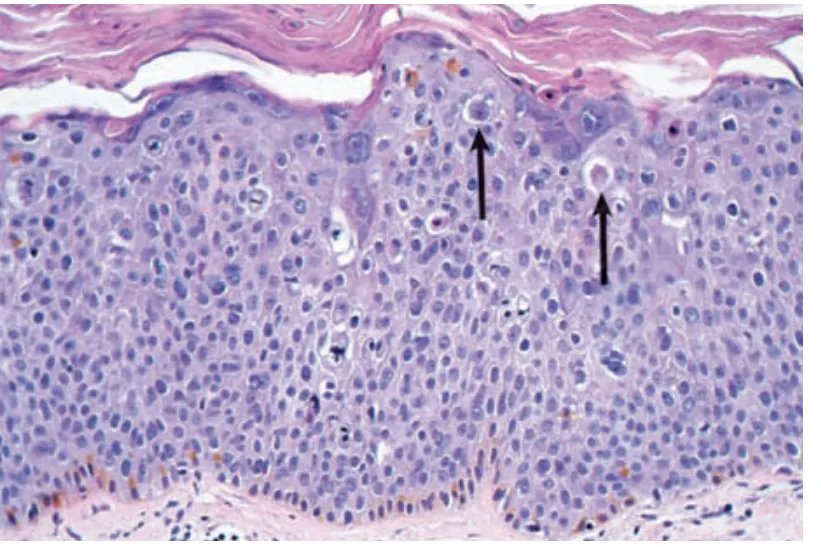
Which protein is most important in mediating the programmed cell death of these tumor cells?
- Q4Transcoelomic seeding and CA-125Connects 7.3 + 7.6Ch. VII cases p.9L7 p.10, 26
A 67-year-old woman with papillary serous cystadenocarcinoma of the ovary dies 3 years after diagnosis. At autopsy her peritoneum is studded with small tumor nodules and there are 4 L of ascites.
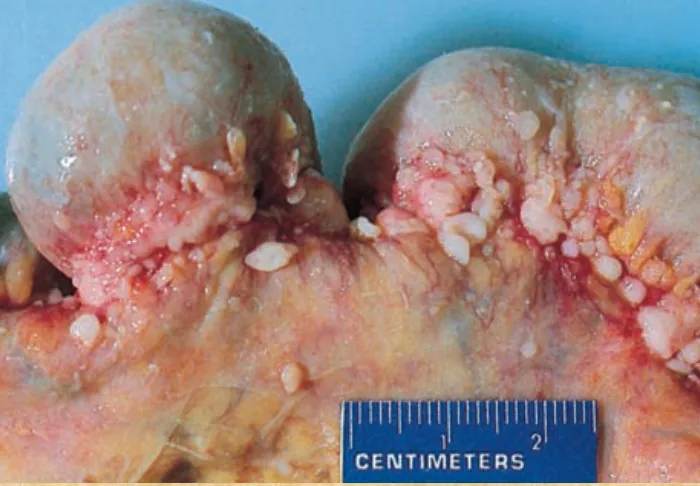
Which route of spread produced these findings, and which serum marker would have been used to follow her disease?
- Q5In situ versus invasive carcinomaConnects 7.2 + 7.3Ch. VII cases p.3L7 p.8, 22
A 29-year-old woman with high-risk HPV has a cervical biopsy showing atypical squamous cells with loss of polarity through the full thickness of the epithelium and no maturation. The basement membrane is continuous. A deeper level shows one focus where identical cells lie 3 mm into the stroma, surrounded by dense new collagen.
How should the lesion be reported, and what has changed clinically?
- Q6Portal spread and Trousseau syndromeConnects 7.3 + 7.7Ch. VII cases p.6L7 p.10, 24–25
A 60-year-old man has weight loss and hepatomegaly. CT shows many round nodules of different sizes in both lobes of the liver; biopsy shows mucin-secreting adenocarcinoma. Over the previous 2 months he has had three episodes of tender, cord-like swellings in superficial veins of different limbs.
Which single explanation accounts for both the liver nodules and the venous episodes?
- Q7Grade versus stage in prostate carcinomaConnects 7.3 + 7.6Ch. VII cases p.4L7 p.11, 24
An 80-year-old man with weight loss has a PSA of 8.5 ng/mL and a nodular prostate. Needle biopsy shows invasive adenocarcinoma composed of fused, poorly formed glands. MRI shows extension through the capsule, and a bone scan shows several dense lesions in the lumbar spine.
Which pair correctly separates the grading information from the staging information?
- Q8Osteoblastic bone metastasesConnects 7.3 + 7.7L7 p.11
The same 80-year-old man's bone scan shows multiple dense (sclerotic) lesions in the vertebrae and pelvis. Serum alkaline phosphatase is raised; serum calcium is normal.
What is happening in the bone?
- Q9Interpreting an IHC panelConnects 7.1 + 7.6L7 p.23
A 70-year-old woman has an enlarged supraclavicular node. Biopsy shows sheets of large, poorly differentiated cells. Immunohistochemistry: cytokeratin positive; CD45, S-100 and desmin negative; TTF-1 positive.
What is the best interpretation?
- Q10Two-hit hypothesis and second primariesConnects 7.4 + 7.1L7 p.19
A 14-year-old boy has an osteosarcoma of the distal femur. He had tumors removed from both eyes as an infant. His father is healthy.
Which statement best explains his two tumors?
- Q11Klinefelter syndrome and breast cancer riskConnects 7.4Midterm sim. p.11–12L5 p.16
A 16-year-old boy with poor school performance is at the 94th percentile for height with long limbs, gynecomastia, sparse pubic hair and small firm testes. LH and FSH are raised and testosterone is slightly low.
He is at greatest risk of developing which cancer?
- Q12Chemical carcinogens and viral co-factorsConnects 7.5 + 7.4L7 p.16–17
A 54-year-old man from a region where maize is stored in hot, humid conditions has chronic hepatitis B and develops a liver mass. Biopsy shows hepatocellular carcinoma; sequencing finds a G:C → T:A transversion at codon 249 of TP53.
Which statement about this tumor is correct?
- Q13HPV E6 and E7Connects 7.5 + 7.4L7 p.17, 19
In an HPV 16-positive cervical carcinoma, the tumor cells continue through the cell cycle despite extensive DNA damage, and apoptosis is not triggered.
Which pairing of viral protein and target explains this?
- Q14Ectopic ACTHConnects 7.7 + 7.6L7 p.25
A 62-year-old smoker with a hilar lung mass has muscle weakness, hypertension, hyperglycemia and a serum potassium of 2.8 mmol/L with a metabolic alkalosis. Plasma ACTH is high and does not suppress with high-dose dexamethasone.
Which tumor and mechanism fit best?
- Q15Cachexia and anemia of chronic diseaseConnects 7.7L7 p.24
A 71-year-old woman with metastatic gastric carcinoma has lost 14 kg in 5 months. She has lost muscle bulk as well as fat, and supplementary feeding has not reversed it. Hemoglobin is 9.4 g/dL with a low serum iron, a normal ferritin and a low transferrin saturation.
Which pair of mechanisms explains her weight loss and her anemia?
- Q16Lineage, stain and paraneoplastic syndrome togetherConnects 7.1 + 7.6 + 7.7Ch. VII cases p.5L7 p.23, 25
A 60-year-old man who has smoked for 40 years has a 10-cm mass obstructing the left main bronchus. The biopsy is shown.
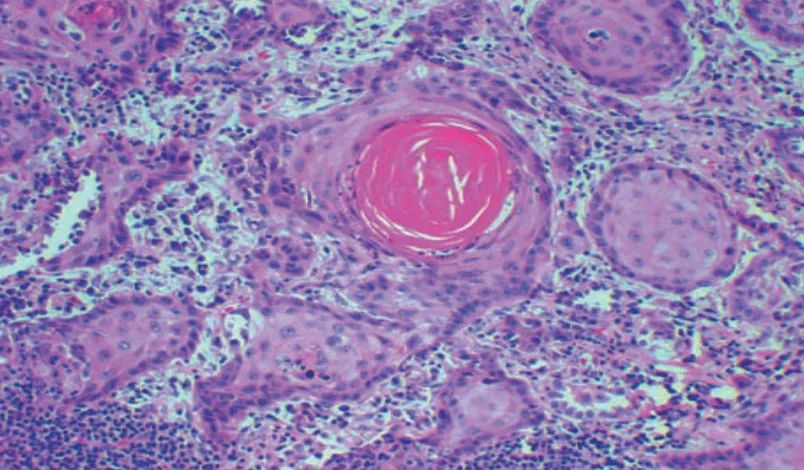
Which combination of findings would you expect in this patient?
- Q17Acanthosis nigricans as a paraneoplastic signConnects 7.7 + 7.6Ch. VII cases p.7L7 p.25
A 59-year-old woman has velvety, thickened, darkly pigmented skin in both axillae, on the neck and in the anogenital region, which appeared over 4 months. She has lost weight. Adrenal steroid levels are normal.
Which investigation is most likely to find the cause?
Want exam conditions? Take the single-answer review items as a timed quiz in the standard AL-MED quiz player.
Timed practice