Interactive lab
Four core activities
Every activity uses real chapter content and keeps your progress in both study modes. Each also appears inside the topic where it helps most.
Break the neutrophil pathway one inherited defect at a time; predict blood and tissue before the reveal.
In context: 2.3 Find the broken step →Centerpiece · Recruitment and killing lab
Find the broken step
0 of 5 defects worked out.
Step 1 · Rolling
E-/P-selectin ↔ sialyl-Lewis X; L-selectin
Selectins on activated endothelium catch sugar ligands on the neutrophil. Bonds form and break, so the cell tumbles slowly along the venule wall.
Tap each step to see its molecules. When the sequence is clear, choose defect 1 above and break it.
Transfer round · same mechanisms, new wording
Work out all five defects above to open five short cases that describe them in different words.
Six chains: vascular, fever, airway, oxidative burst, granuloma loop, resolution.
In context: 2.1, 2.3, 2.4, 2.5, 2.6 →Core activity · The Missing Arrow
The Missing Arrow
A bee stings the back of a hand. Complete the chain from the first mediator to leukocytes lining the venule wall.
Two gaps ask for a mechanism (how one event causes the next); three ask for an event (what you would see).
- Mast cells around the sting degranulate and release histamine
- histamine also makes endothelial cells of postcapillary venules contract
- Flow slows in the small vessels: stasis
- in slow flow, leukocytes drift out of the central stream
Cards
Tap or drag a card. Placing a used card moves it.
Granuloma vs granulation tissue, caseating vs non-caseating, hypertrophic scar vs keloid, exudate vs transudate.
In context: 2.1, 2.6, 2.7 →Core activity · Almost Twins
Almost Twins
Look-alike A
Granuloma
Lecture image
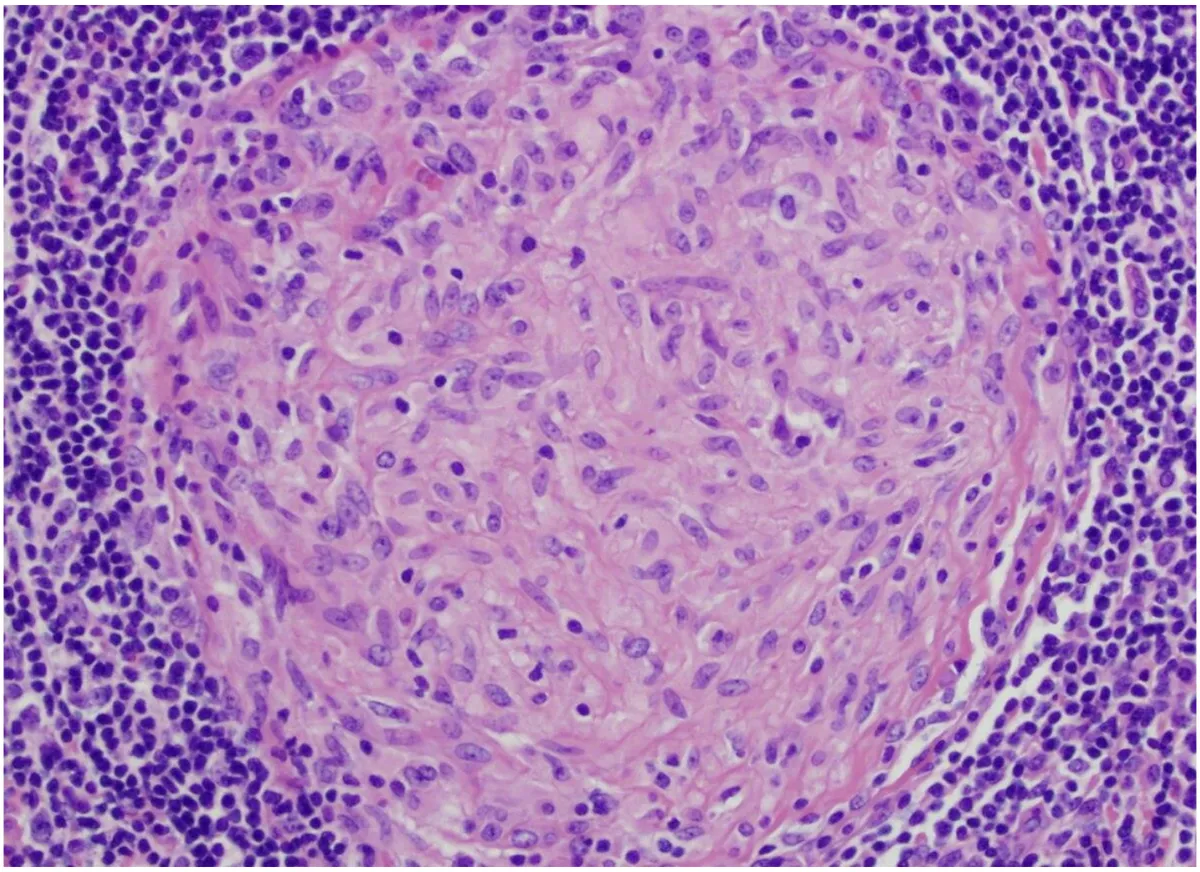
- Contains macrophages
- Compact nodule of epithelioid macrophages, giant cells, lymphocyte cuff
- Driven by IL-12 → Th1 → IFN-γ; TNF holds it together
- Purpose: contain an agent that cannot be destroyed
Look-alike A
Granuloma
Lecture image
- Contains macrophages
- Compact nodule of epithelioid macrophages, giant cells, lymphocyte cuff
- Driven by IL-12 → Th1 → IFN-γ; TNF holds it together
- Purpose: contain an agent that cannot be destroyed
Look-alike B
Granulation tissue
Lecture image
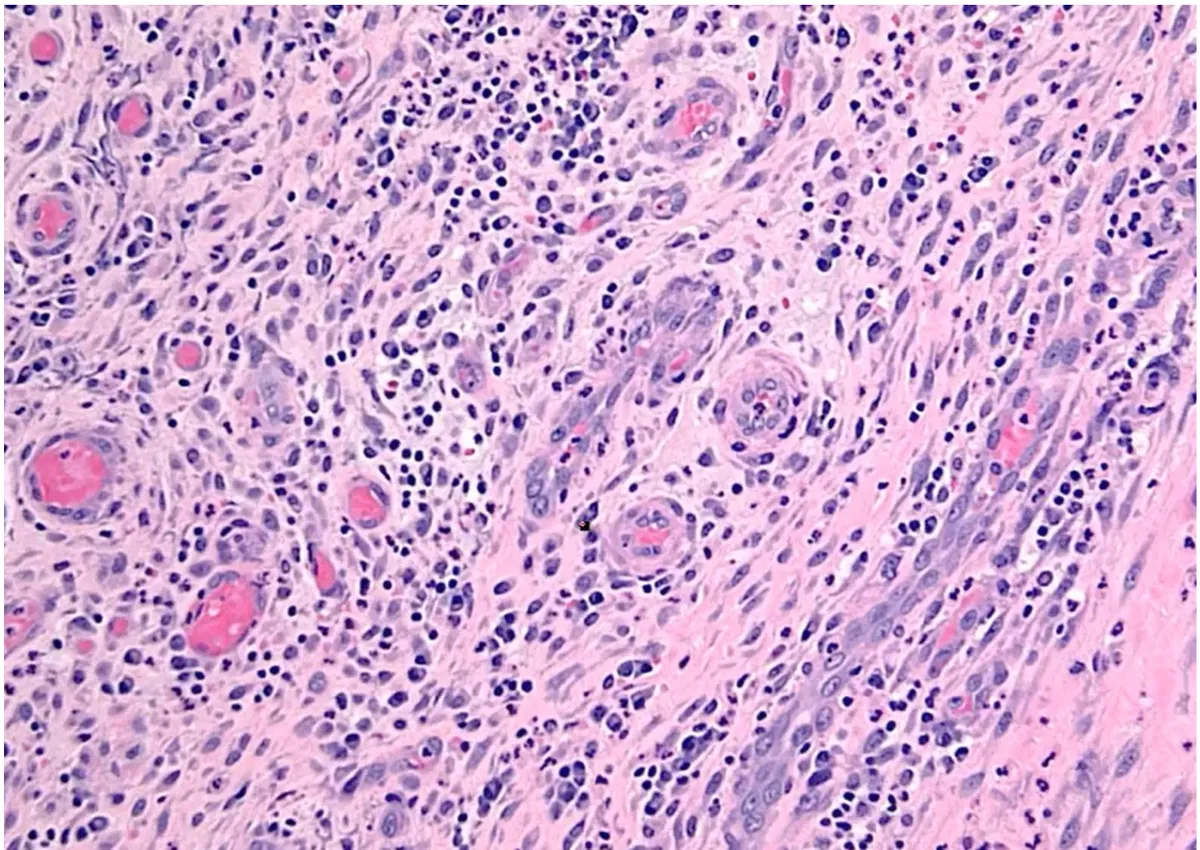
- Contains macrophages
- Diffuse layer of new capillaries with fibroblasts and myofibroblasts
- Driven by VEGF, FGF, PDGF and TGF-β
- Purpose: fill a defect; becomes scar
Step 1 · What they share
What do these two share?
Select every feature that both show.
Change the day, the closure, the history or the biopsy, and decide whether the answer moves.
In context: 2.1, 2.2, 2.6, 2.7 →Core activity · One Fact Changes
One Fact Changes
1 · The original case
A 64-year-old man with diabetes has crushing chest pain. His occluded left anterior descending artery cannot be opened in time. He dies of an arrhythmia 2 days later. The anterior wall is examined microscopically.
What dominates the infarcted myocardium?
Which fact decided it?