The 22 bones in two groups
An adult skull is 22 bones: 8 cranial bones around the brain and 14 facial bones around the mouth, nose and eyes. Learn the inventory once, with its pairs and its exclusions, and every later detail has a place to go.
Twenty-two bones: 8 cranial and 14 facial
OpenStaxNetter p.9–10Netter p.13–14The adult skull is made of 22 bones. Twenty-one of them are locked together by sutures into a single rigid unit. The twenty-second, the mandible, is the lower jaw and the only one that moves. The 22 fall into the two groups you met in section 1: 8 cranial bones, which enclose the brain, and 14 facial bones, which form the skeleton of the face.
The 8 cranial bonesOpenStax
| Bone | Number | Where it is |
|---|---|---|
| Frontal | 1 | Forehead and the roofs of the orbits |
| Parietal | 2 | Top and upper sides of the vault |
| Temporal | 2 | Lower sides of the braincase, around each ear |
| Occipital | 1 | Back of the head and the back of the base |
| Sphenoid | 1 | Center of the base, reaching out to each temple |
| Ethmoid | 1 | Between the orbits, in the roof of the nasal cavity |
- Number
- 1
- Where it is
- Forehead and the roofs of the orbits
- Number
- 2
- Where it is
- Top and upper sides of the vault
- Number
- 2
- Where it is
- Lower sides of the braincase, around each ear
- Number
- 1
- Where it is
- Back of the head and the back of the base
- Number
- 1
- Where it is
- Center of the base, reaching out to each temple
- Number
- 1
- Where it is
- Between the orbits, in the roof of the nasal cavity
The 14 facial bonesOpenStax
| Bone | Number | Where it is |
|---|---|---|
| Maxilla (plural maxillae) | 2 | Upper jaw and the center of the face |
| Zygomatic | 2 | Cheekbones |
| Nasal | 2 | Bridge of the nose |
| Lacrimal | 2 | Front of the inner (medial) wall of each orbit |
| Palatine | 2 | Back of the hard palate and the side walls of the nasal cavity |
| Inferior nasal concha (plural conchae) | 2 | A curled shelf low on each side wall of the nasal cavity |
| Vomer | 1 | Lower back part of the nasal septum |
| Mandible | 1 | Lower jaw |
Maxilla (plural maxillae)
- Number
- 2
- Where it is
- Upper jaw and the center of the face
- Number
- 2
- Where it is
- Cheekbones
- Number
- 2
- Where it is
- Bridge of the nose
- Number
- 2
- Where it is
- Front of the inner (medial) wall of each orbit
- Number
- 2
- Where it is
- Back of the hard palate and the side walls of the nasal cavity
Inferior nasal concha (plural conchae)
- Number
- 2
- Where it is
- A curled shelf low on each side wall of the nasal cavity
- Number
- 1
- Where it is
- Lower back part of the nasal septum
- Number
- 1
- Where it is
- Lower jaw
The arithmetic
- Cranial: 4 single bones + 2 pairs = 8
- Facial: 6 pairs + 2 single bones = 14
- Skull: 8 + 14 = 22
Specimen still
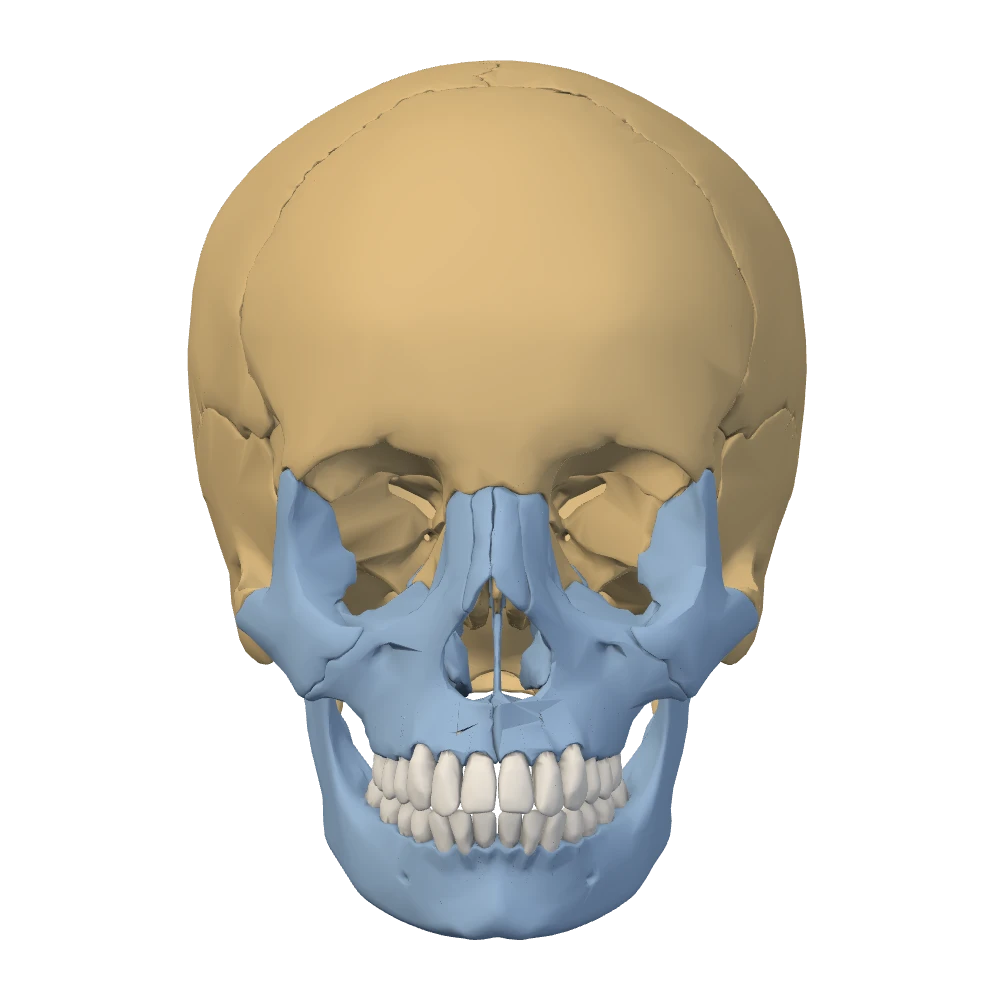
Anterior view. Facing the skull: the patient's left is on your right.
What the names meanMore detail
Most of the names say where the bone is or what it looks like, which makes them easier to keep.
| Name | From | So the bone is |
|---|---|---|
| Frontal | Latin frons, forehead | The forehead bone |
| Parietal | Latin paries, wall | The wall of the vault |
| Temporal | Latin tempora, the temples | The bone of the temple and ear |
| Occipital | Latin occiput, back of the head | The bone at the back |
| Sphenoid | Greek sphen, wedge | The wedge in the middle of the base |
| Ethmoid | Greek ethmos, sieve | The bone with a sieve-like plate |
| Maxilla | Latin maxilla, jaw | The upper jaw |
| Zygomatic | Greek zygon, yoke | The bone that yokes face to braincase |
| Lacrimal | Latin lacrima, tear | The bone beside the tear passage |
| Palatine | Latin palatum, palate | The bone of the palate |
| Concha | Latin concha, shell | A shell-like scroll |
| Vomer | Latin vomer, plowshare | A flat blade in the septum |
| Mandible | Latin mandere, to chew | The chewing bone |
Frontal
- From
- Latin frons, forehead
- So the bone is
- The forehead bone
Parietal
- From
- Latin paries, wall
- So the bone is
- The wall of the vault
Temporal
- From
- Latin tempora, the temples
- So the bone is
- The bone of the temple and ear
Occipital
- From
- Latin occiput, back of the head
- So the bone is
- The bone at the back
Sphenoid
- From
- Greek sphen, wedge
- So the bone is
- The wedge in the middle of the base
Ethmoid
- From
- Greek ethmos, sieve
- So the bone is
- The bone with a sieve-like plate
Maxilla
- From
- Latin maxilla, jaw
- So the bone is
- The upper jaw
Zygomatic
- From
- Greek zygon, yoke
- So the bone is
- The bone that yokes face to braincase
Lacrimal
- From
- Latin lacrima, tear
- So the bone is
- The bone beside the tear passage
Palatine
- From
- Latin palatum, palate
- So the bone is
- The bone of the palate
Concha
- From
- Latin concha, shell
- So the bone is
- A shell-like scroll
Vomer
- From
- Latin vomer, plowshare
- So the bone is
- A flat blade in the septum
Mandible
- From
- Latin mandere, to chew
- So the bone is
- The chewing bone
Paired and unpaired: why left and right count separately
OpenStaxA paired bone is really two bones, one on each side, built as mirror images of each other. The left and right parietal bones are separate pieces that meet at a suture on top of the head. A pair therefore counts as two. An unpaired bone is a single piece that lies across the midline, with a right half and a left half that match.
Unpaired: 6 bones on the midline
Some pairs touch each other in the midline, which makes them easy to mistake for one bone. The two nasal bones lie side by side on the bridge of the nose. The two maxillae meet below the nasal opening and along the middle of the palate. The two palatine bones meet at the back of the palate. Other pairs never touch: the temporal bones are a head's width apart. Tap left maxilla, then right maxilla, and find the seam between them.
What is not counted: teeth, ossicles, hyoid
Netter p.9–10OpenStaxThree sets of hard structures are closely tied to the skull but are left out of the 22. Knowing why keeps your count the same as the examiner's.
Outside the 22Netter p.9–10OpenStax
| Structure | How many | Where | Why it is not one of the 22 |
|---|---|---|---|
| Teeth | 32 in a full adult set | 16 in the sockets of the two maxillae, 16 in the mandible | Teeth are not bone. They are made of dentine capped with enamel, and each is held in its socket by a ligament |
| Auditory ossicles: malleus, incus, stapes | 6 (3 in each ear) | In the middle ear, a cavity inside the temporal bone | They are separate small bones of the ear, hidden within the temporal bone, and are listed as associated bones |
| Hyoid bone | 1 | In the front of the neck, just below the mandible | It touches no other bone. Muscles and ligaments suspend it from the skull |
Teeth
- How many
- 32 in a full adult set
- Where
- 16 in the sockets of the two maxillae, 16 in the mandible
- Why it is not one of the 22
- Teeth are not bone. They are made of dentine capped with enamel, and each is held in its socket by a ligament
Auditory ossicles: malleus, incus, stapes
- How many
- 6 (3 in each ear)
- Where
- In the middle ear, a cavity inside the temporal bone
- Why it is not one of the 22
- They are separate small bones of the ear, hidden within the temporal bone, and are listed as associated bones
Hyoid bone
- How many
- 1
- Where
- In the front of the neck, just below the mandible
- Why it is not one of the 22
- It touches no other bone. Muscles and ligaments suspend it from the skull
On the specimen the teeth are separate pieces, the upper teeth and the lower teeth, so that you can tell tooth from jaw. The upper teeth sit in the maxillae and the lower teeth in the mandible; a tooth socket is called an alveolus, and the ridge of bone that carries the sockets is the alveolar part of each jaw. The ossicles and the hyoid are not part of this specimen.
Add the associated bones and the totals you meet in other books make sense: 22 skull bones plus 6 ossicles is 28, and the hyoid makes 29. The number for the skull itself stays 22.
A reliable way to count them
A list of 22 names is easy to lose. Count the bones along a fixed route instead, and count every pair as two.
Cranial bones, around the braincase (8).
- Front: frontal (1).
- Top and sides: parietal (2), then down to temporal (2).
- Back: occipital (1).
- Center of the floor: sphenoid (1), and in front of it ethmoid (1).
Facial bones, from the bridge of the nose downward (14).
- Bridge of the nose: nasal (2).
- Step back into the orbit: lacrimal (2).
- Out to the cheek: zygomatic (2).
- Down to the upper jaw: maxilla (2).
- Behind the maxillae, in the palate: palatine (2).
- Inside the nose, on each side wall: inferior nasal concha (2).
- Inside the nose, in the midline: vomer (1).
- Lower jaw: mandible (1).
Check the total three ways
- By group: 8 cranial + 14 facial = 22.
- By pairing: 6 single bones + 8 pairs (16 bones) = 22.
- By tapping: select each bone once on the specimen, both members of every pair. You should make 22 selections.
Many students keep the cranial bones with the letters PEST OF: Parietal, Ethmoid, Sphenoid, Temporal, Occipital, Frontal. It works only if you remember that P and T each stand for two bones.
Which bones show in which view
Netter p.9–18OpenStaxNo single view shows all 22 bones. Some are on display from several directions; some are almost entirely hidden inside the face. Knowing what to expect in each view tells you where to look, and it stops you searching for a bone that cannot be seen from where you are.
Bones to expect in each viewNetter p.9–18OpenStax
| View | On the surface | Inside, or hidden |
|---|---|---|
| Anterior | Frontal, nasal, maxillae, zygomatic, mandible; the temporal and parietal bones as narrow edges at the sides | In the orbit: lacrimal, ethmoid, sphenoid. In the nasal opening: the inferior nasal conchae and the septum, ethmoid above and vomer below |
| Lateral | Frontal, parietal, temporal, occipital, the greater wing of the sphenoid, zygomatic, maxilla, nasal, mandible | The lacrimal bone can be seen in the medial wall of the orbit. The bones of the nasal cavity and the opposite side are hidden |
| Posterior | Occipital, both parietal bones, the mastoid region of both temporal bones; the mandible below | The rest of the face is hidden behind the braincase |
| Superior | Frontal, both parietal bones, and the top of the occipital bone at the back | The base and almost all of the face are hidden beneath the vault |
| Inferior, mandible removed | Maxillae and palatine bones in the palate, zygomatic, vomer, sphenoid, temporal, occipital | Nasal, lacrimal and ethmoid bones are hidden above the palate |
| Internal cranial base | Frontal, ethmoid, sphenoid, both temporal bones, occipital, with the cut rim of the vault around them | No facial bone: the floor of the cranial cavity is made by cranial bones only |
| Midsagittal section | The midline bones cut through (frontal, ethmoid, sphenoid, occipital, vomer, mandible) and the inner faces of one parietal, temporal, nasal, maxilla and palatine bone | With the septum removed, the side wall of the nasal cavity and its conchae |
Anterior
Lateral
Posterior
- On the surface
- Occipital, both parietal bones, the mastoid region of both temporal bones; the mandible below
- Inside, or hidden
- The rest of the face is hidden behind the braincase
Superior
- On the surface
- Frontal, both parietal bones, and the top of the occipital bone at the back
- Inside, or hidden
- The base and almost all of the face are hidden beneath the vault
Inferior, mandible removed
- On the surface
- Maxillae and palatine bones in the palate, zygomatic, vomer, sphenoid, temporal, occipital
- Inside, or hidden
- Nasal, lacrimal and ethmoid bones are hidden above the palate
Internal cranial base
- On the surface
- Frontal, ethmoid, sphenoid, both temporal bones, occipital, with the cut rim of the vault around them
- Inside, or hidden
- No facial bone: the floor of the cranial cavity is made by cranial bones only
Midsagittal section
- On the surface
- The midline bones cut through (frontal, ethmoid, sphenoid, occipital, vomer, mandible) and the inner faces of one parietal, temporal, nasal, maxilla and palatine bone
- Inside, or hidden
- With the septum removed, the side wall of the nasal cavity and its conchae
Five bones are easy to forget because so little of them reaches the outside: the ethmoid, the vomer, the palatine bones, the inferior nasal conchae and the lacrimal bones. Select each one from the table above and rotate the specimen until you can see it.
The sphenoid is the opposite case. It appears in almost every view: in the temple from the side, at the back of the orbit from the front, between the palate and the occipital bone from below, and across the middle of the floor from inside. Yet each view shows only a small part of it. You never see the whole sphenoid on an assembled skull.
Specimen still
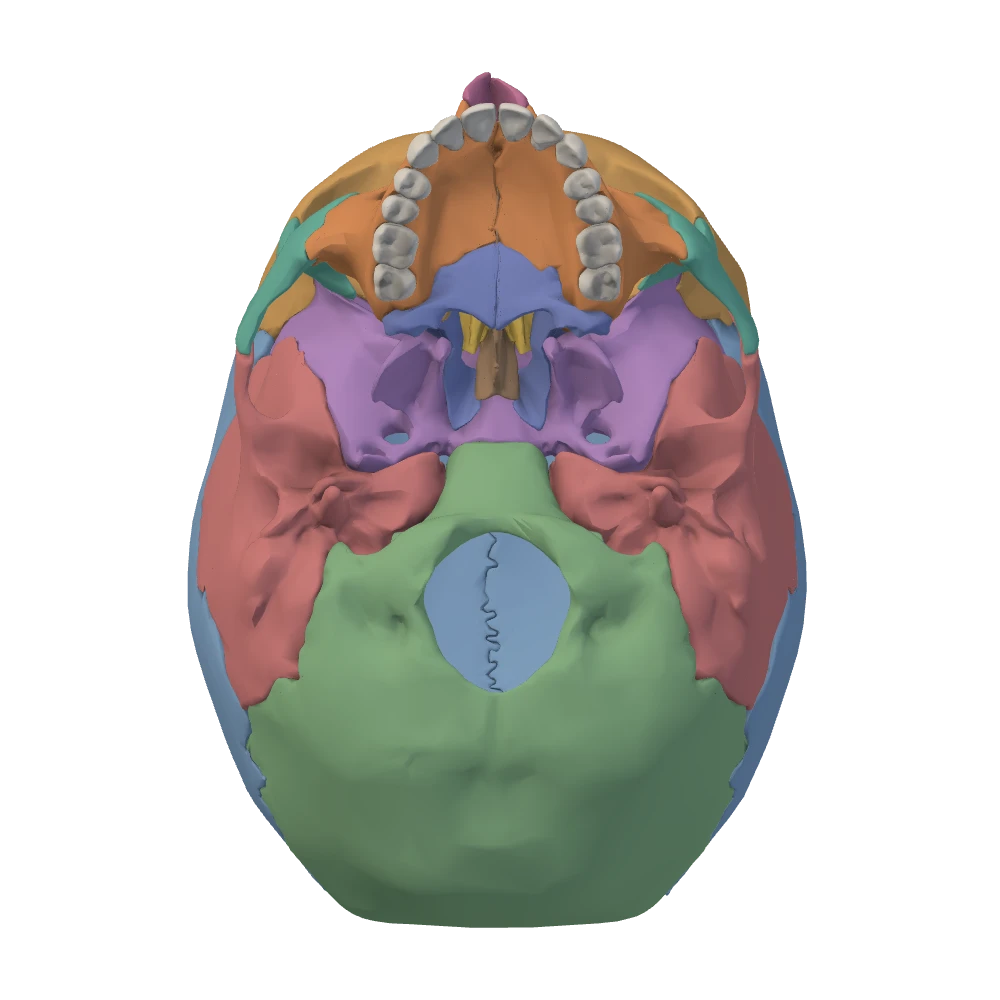
Inferior (external base) view. From below, mandible removed: the face is toward the top, the patient's left is on your right.
Knowledge check · 2
Answer, read why, and try again whenever you like. Answers are kept in both study modes.
- Q1Group membership: the 8 cranial bonesOpenStaxNetter p.9–10
Which list contains only cranial bones?
- Q2Paired and unpaired facial bonesOpenStaxNetter p.13–14
How many of the 14 facial bones are unpaired?
- Q3Outside the count: ossicles and hyoidNetter p.9–10
A textbook says that the skull and its associated bones number 29. What has been added to the 22 bones of the skull?
- Q4Recognize the sphenoid; unpaired bone with paired partsBodyParts3DOpenStaxNetter p.11–12
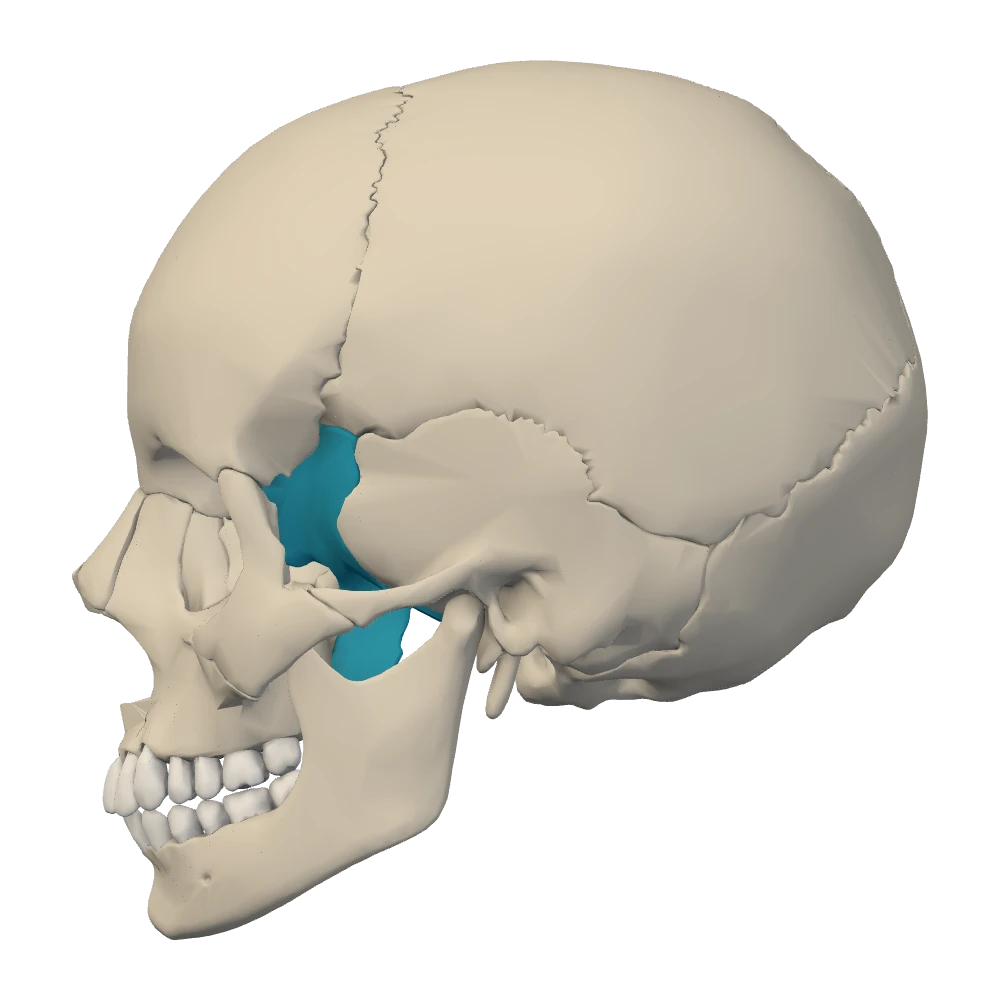
Left lateral view. The patient's left side: the face points to your left.
In this left lateral view one bone is highlighted. Only a small part of it reaches the side of the skull. To which group does it belong, and is it paired?
- Q5Which bones show in the posterior viewOpenStax
Which of these bones can you not see in a posterior view of the assembled skull?
- Q6Counting pitfall: conchaeOpenStaxNetter p.15–16
Each side wall of the nasal cavity carries three conchae. How many of the six are counted as separate bones of the skull?
- Q7Left and right of a paired bone in the anterior viewOpenStaxBodyParts3D
In the anterior view the two maxillae meet in the midline below the nasal opening. What is the maxilla on the left of the picture?
- Q8The mandible is the only movable boneOpenStax
Which of the 22 bones is joined to the rest of the skull by a movable joint and not by sutures?